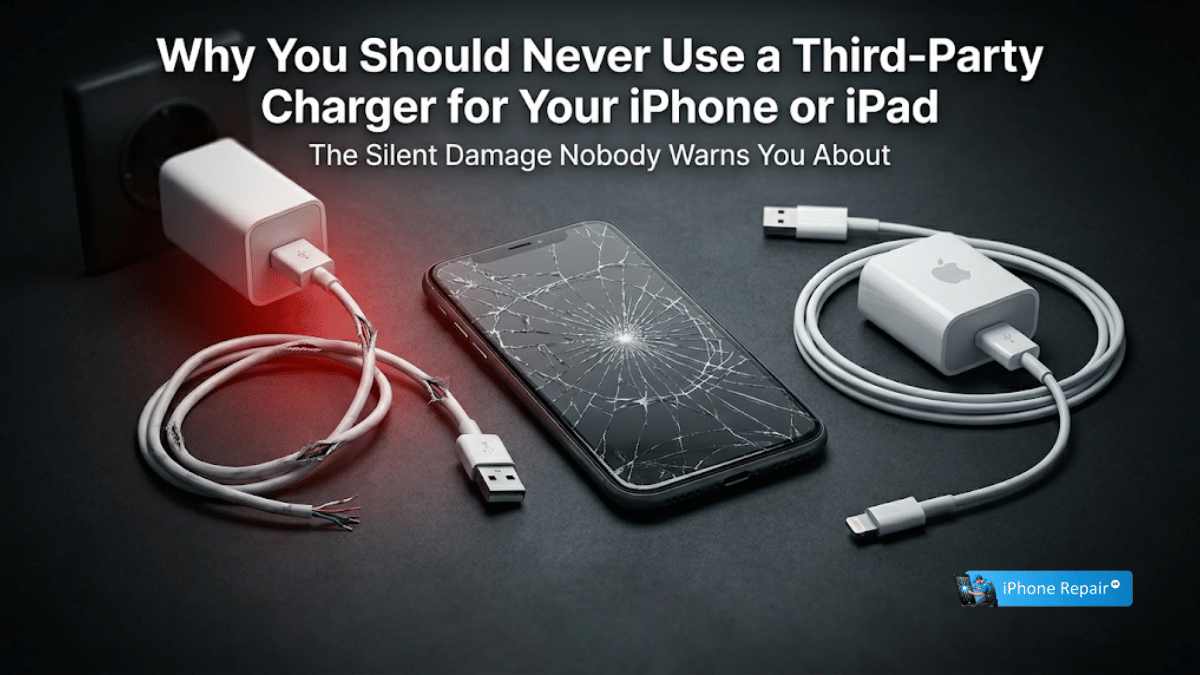
Your iPhone or iPad is one of the most valuable pieces of technology you own. It holds your photos, your messages, your banking apps, your work documents, and the small everyday details that make modern life run smoothly. Yet many people happily plug all of that into a charger they bought for £3 at a service station, a cable they grabbed from a market stall, or a power brick that came free with an unrelated gadget. The risk of third-party iPhone charger damage is one of the most underestimated threats to Apple devices in the UK today, and the consequences range from a slightly underperforming battery to a phone that will not power on at all.
This guide explains, in detail, why third-party chargers are so dangerous, how cheap charger damage iPhone reports actually unfold inside the device, what the real non-Apple charger risks look like in 2026, and the iPhone charging safety tips you can apply right now to protect iPhone battery life. By the end, you will know exactly what to look for, what to avoid, and what to do if you suspect your charger has already caused harm.
The Hidden Cost of a Cheap Charger
When you buy a generic charger for a few pounds, you are not just buying a slower or less elegant accessory. You are buying a power supply that has, in many cases, never been tested to the same electrical, thermal, or safety standards Apple requires. The reason a genuine Apple charger or a properly certified third-party alternative costs more is because the components inside it are dramatically different. A real charger contains regulated voltage circuitry, surge protection, a properly shielded transformer, certified capacitors, and firmware that communicates with your iPhone to negotiate the correct charging speed.
A cheap knockoff often contains none of these things. Independent teardown reports from electrical safety bodies in the UK and Europe have repeatedly found counterfeit chargers with insufficient insulation between the high-voltage mains side and the low-voltage USB side, which can allow a 230V shock to reach your fingers or your phone. They also found undersized or missing fuses, meaning a fault that would normally blow a fuse instead routes mains current straight into your device. Fake regulatory markings are printed on the casing, including counterfeit CE and UKCA logos. Capacitors are rated for far lower voltages than they will actually see in normal UK mains use, leading to silent failures. Loose or unsecured solder joints can vibrate free during normal handling, creating short circuits.
The result is a power supply that may work fine for a few weeks, then quietly start damaging your phone, and in the worst cases, become a fire hazard sitting next to your bed.
What Actually Happens Inside Your iPhone When You Use a Bad Charger
To understand third-party iPhone charger damage properly, it helps to know how an iPhone is supposed to charge. Modern iPhones do not simply accept whatever electricity is offered to them. Instead, they negotiate. The phone communicates with the charger through a small controller chip, traditionally known as the Tristar or U2 chip on older devices and updated equivalents on newer models. This chip manages the flow of power into the battery, regulates voltage, and protects the logic board from spikes.
When you plug in a properly certified charger, the conversation is clean. The charger announces what it can deliver, the iPhone confirms what it wants, and the power flows in a controlled way. When you plug in a cheap knockoff that does not follow Apple’s specifications, several things can go wrong. The charger may deliver inconsistent voltage, forcing the controller chip to compensate constantly until it overheats or fails. The charger may push the wrong amperage at startup, before the controller can throttle it, sending a surge through the logic board. The charger may fail to ground properly, which causes phantom touches on your screen, ghost typing, or the screen registering taps that never happened. The charger may not communicate at all, leaving the phone unsure how much power it can safely accept, which is why so many cheap chargers cause charging slow warnings or stop charging entirely after a few minutes.
Over weeks and months, this electrical mistreatment quietly degrades the battery, the charging port, and sometimes the logic board itself. By the time you notice the problem, you may already be looking at a repair that costs more than a year’s worth of genuine cables.
The Five Most Common Forms of Damage Caused by Non-Apple Chargers
Understanding the specific failure modes helps you spot trouble early. These are the patterns iPhone repair technicians see most frequently in UK workshops.
Battery Degradation That Arrives Years Too Early
Apple lithium-ion batteries are designed to retain around 80 percent of their original capacity after 500 full charge cycles. A poor charger can cause that drop to happen in a fraction of the time. Inconsistent voltage causes uneven cell wear, while heat generated during bad charging accelerates the chemical aging of the battery. If your phone is two years old and already shows a Maximum Capacity below 80 percent in the Battery Health menu, your charging habits are a likely suspect.
Charging Port Wear and Bent Contacts
Cheap Lightning and USB-C cables often have slightly out-of-spec connectors. They feel marginally tight or loose when you plug them in. Over time, this stresses the pins inside your charging port, eventually causing them to bend, oxidise, or break. The phone starts to charge only at certain angles, then only with the cable propped up by a book, then not at all.
Tristar or Charging IC Failure
This is the most expensive form of damage. When the charging management chip on the logic board burns out due to repeated voltage abuse, the phone cannot charge regardless of which cable you use afterwards. Symptoms include a phone that shows the lightning bolt icon without actually charging, a phone that charges only when switched off, or a phone that suddenly refuses to power on at all.
Touchscreen Ghosting and Erratic Input
A surprising number of my screen has gone mad complaints turn out to be charger-related. When a cheap charger fails to ground properly or feeds inconsistent voltage, the iPhone display registers phantom touches, types on its own, or fails to respond accurately. The fault often disappears the moment the charger is unplugged.
Catastrophic Failure or Fire
This is the rarest outcome but the most serious. UK trading standards have repeatedly issued recall notices for counterfeit Apple chargers that were found capable of causing electric shocks or igniting under load. Reports of phones swelling, melting, or igniting on bedside tables almost always trace back to a non-certified charger.
Why “It Works Fine” Is Not the Argument People Think It Is
The most common defence of cheap chargers is that they have been working without issue for months. The problem with this argument is that the damage caused by bad charging is cumulative and largely invisible until it is severe. A poorly regulated charger does not announce itself with sparks. It quietly trims a few percentage points off your battery health each month, slowly wears the contacts in your charging port, and gradually stresses components on the logic board. By the time the phone visibly misbehaves, the cause is months or years in the past, and the user rarely connects the two.
Think of it the way you would think of running your car on bad fuel. The engine still starts. It still drives. Nothing dramatic happens for a long time. Then one day the fuel pump fails, the injectors clog, or the catalytic converter dies, and you find yourself paying far more than you ever saved at the cheap petrol station. iPhones work the same way, only with smaller margins because the components are tighter, more delicate, and far harder to access for repair.
How to Identify a Safe Charger in the UK
You do not need to buy only Apple-branded chargers to be safe. Several reputable brands produce genuinely well-engineered third-party chargers that meet or exceed Apple’s specifications. The challenge is separating these from the counterfeits that flood online marketplaces. Use this checklist before plugging anything into your iPhone or iPad.
Look for MFi certification. MFi stands for Made for iPhone, iPad, or iPod. It is Apple’s licensing programme for certified accessories, and it is the single most reliable indicator that a cable or charger has passed Apple’s electrical and quality tests. The certification logo appears on the packaging and often on the cable itself.
Look for proper UK regulatory markings. Genuine chargers sold in the UK carry the UKCA mark and the older CE mark, alongside a clear manufacturer name and address. Counterfeit chargers often print these symbols incorrectly, in the wrong font, or in the wrong colour.
Check the weight. A real Apple-spec charger contains real components. A counterfeit is usually much lighter because it has fewer or smaller internal parts. If a charger feels suspiciously empty in your hand, it almost certainly is.
Inspect the build quality. Look at the seams, the moulding around the prongs, the printing on the casing, and the finish on the USB or Lightning connector. Counterfeits frequently have rough seams, slightly off-centre logos, or visible glue.
Buy from authorised retailers. John Lewis, Currys, the Apple Store, and the major mobile network shops including EE, Vodafone, O2, and Three source their accessories through verified channels. Random listings on auction sites and unfamiliar web shops are a far higher risk.
Avoid chargers without a brand name. If the packaging does not clearly state who made it, do not plug it in. Manufacturers willing to put their name on a product have something to lose if it fails.
Trusted third-party brands that genuinely produce safe, MFi-certified accessories include Anker, Belkin, Ugreen, Mophie, and Satechi. Even within these brands, however, you should buy from official channels, because counterfeit listings using legitimate brand names appear regularly on online marketplaces.
The Connection Between Chargers and Charging Port Damage
One of the most overlooked consequences of using non-Apple chargers is the damage they inflict on the charging port itself. Lightning and USB-C ports inside an iPhone are precision components. The pins that make contact with the cable are tiny, gold-plated, and designed to mate with connectors built to exact tolerances. When a cheap cable is even slightly out of specification, every insertion and removal stresses those pins.
Common signs of charging port damage caused by bad cables include the phone only charging when the cable is held at a specific angle, the cable falling out of the port too easily, the phone repeatedly disconnecting and reconnecting while charging, visible debris or oxidation inside the port when viewed under a torch, and a repeated beep or notification sound as the phone toggles between charging and not charging.
If you recognise any of these patterns, a professional iPhone & iPad charging port replacement is usually the right next step, because the longer you wait, the more likely the damage spreads from the port itself to the flex cable that connects it to the logic board.
Why Battery Health Suffers Faster With Cheap Chargers
Your iPhone’s lithium-ion battery is engineered to handle a specific range of charging behaviours. Apple’s charging algorithms, including Optimised Battery Charging introduced in iOS 13 and refined in subsequent updates, deliberately slow charging during certain phases to extend battery longevity. This algorithm assumes the charger is well-behaved. When the charger is not, the algorithm cannot fully protect the battery.
Heat is the single biggest enemy of lithium-ion chemistry. Every degree above the ideal temperature accelerates capacity loss. A cheap charger that runs hot itself, or that delivers irregular current that forces the battery to work harder, increases internal heat in the cell. The result is a battery that ages in calendar months what a genuine charger would age in years.
If your battery health has dropped below 80 percent and your phone is less than two years old, replacement is usually the most cost-effective path back to all-day use. A professional Apple battery replacement using high-quality cells, performed by a skilled technician, restores both capacity and the proper charging curve, particularly when paired with a switch back to certified charging accessories.
Wireless Chargers Are Not Automatically Safer
Many people assume that wireless charging side-steps the third-party charger problem entirely. It does not. A cheap wireless pad has its own risks including poor coil alignment that generates excess heat, lack of foreign object detection that can cause overheating if a coin or key is on the pad, and unregulated power delivery that stresses both the receiver coil in your iPhone and the battery itself.
When choosing a wireless charger, look for Qi certification, with Qi2 being the latest standard officially supported by Apple, MagSafe compatibility for iPhone 12 and later if you want full speed, and a reputable brand. Avoid generic, brandless wireless pads, particularly those that promise unrealistic charging speeds for the price.
Specific UK Risks Worth Knowing About
The UK has some specific charger-related risks that international guides often miss. Our 230V mains supply is significantly higher than the 110V used in North America, which means a counterfeit charger imported from a country with lower mains voltage may be operating well outside its design tolerances when plugged into a UK wall socket. Voltage spikes during storms, common in older British housing stock with less robust earthing, hit cheap chargers harder than certified ones. And the UK three-pin plug includes a fuse for a reason: the cheap two-pin adapters that some imported chargers ship with bypass that protection entirely.
If you travel and want to use foreign chargers in the UK, always use a proper travel adapter with built-in fuse protection, and avoid the cheap blister-pack adapters sold at airport kiosks. Better still, buy a UK-spec charger from a reputable retailer and keep your foreign accessories in your luggage.
What to Do If You Suspect Damage Has Already Happened
If your iPhone or iPad is showing any of the warning signs described above, the worst thing you can do is keep using the same charger and hope the problem resolves itself. It will not. Charger-related damage almost always worsens with continued exposure. The right sequence of steps is as follows.
Stop using the suspect charger immediately and switch to a verified MFi-certified or genuine Apple charger. Check the charging port for visible debris or damage using a torch and a wooden or plastic toothpick to gently clear lint, but never use a metal pin. Check Battery Health by going to Settings, then Battery, then Battery Health and Charging, and note the Maximum Capacity figure and whether iOS reports any performance management or service messages. Test with a different known-good cable and adapter to see whether charging behaviour normalises, which would confirm the original charger was the culprit. If charging does not improve, the iPhone itself has likely sustained damage. Finally, get a professional diagnosis, as a qualified technician can test the charging IC, the port, the battery, and the cable separately to identify exactly which component failed.
If you are in South Wales or anywhere within reach of Newport, you can get your device checked today for a free diagnostic that will tell you exactly what has been damaged and what it will cost to put right. Acting early often means a single inexpensive component swap. Waiting can mean a logic board repair that costs several times more.
Habits That Protect Your iPhone for the Long Term
Beyond choosing the right charger, a few small habits make a meaningful difference to how long your iPhone or iPad lasts on its original battery and original charging port. Keep your phone cool while charging, particularly avoiding charging it under a pillow or in direct sunlight on a windowsill. Avoid charging from zero to one hundred constantly, as lithium-ion batteries actually prefer to live in the 20 to 80 percent range. Use Optimised Battery Charging, which learns your routine and delays the final 20 percent of charging until just before you usually unplug. Keep iOS up to date, because Apple regularly improves charging algorithms in software updates. And replace cables and adapters at the first sign of fraying, bending, or discolouration, because a damaged accessory damages your phone.
The True Economics of Buying a Real Charger
The argument against genuine or certified chargers is almost always price. The argument falls apart the moment you compare the numbers properly. A genuine Apple 20W USB-C power adapter and Lightning cable, or a comparable MFi-certified set from a reputable brand, costs somewhere between £30 and £55 depending on where you buy it and how often it is on offer. A counterfeit charger costs £3 to £10 and may damage your battery, requiring replacement at typically £45 to £90 depending on model. It may damage your charging port, requiring replacement at typically £40 to £100 depending on model. It may damage your logic board’s charging IC, requiring micro-soldering work often costing £80 to £200. And in rare but possible cases, it may damage your entire phone if the fault is severe enough.
Across the lifetime of a single iPhone, the total cost of cheap charging is almost always higher than the cost of certified charging, often by an order of magnitude. The savings exist only on the receipt for the charger itself.
The chargers that come with your iPhone, or that you buy from a reputable retailer with full MFi certification, are not expensive because Apple is greedy. They are expensive because they contain components that have been tested, verified, and built to a standard that protects what is, for most people, one of the most important devices in their lives. A counterfeit charger is, in effect, a tiny mains-powered electrical device with unknown components, made in unknown conditions, sold by an unknown party, plugged into your bedroom wall and connected directly to your most personal data.
Treat your iPhone and iPad with the respect they deserve. Buy genuine or certified accessories. Replace damaged cables promptly. Watch for the warning signs of charger-related harm. And if anything seems wrong, get a proper diagnosis before the small problem becomes a large one. Following these iPhone charging safety tips is the simplest, cheapest insurance policy you can take out on your device, and the difference between protecting iPhone battery life for years and replacing the whole phone twelve months too early.