When your iPhone breaks, you are not just choosing a repair shop. You are choosing who gets to handle the device that holds your photos, your messages, your bank cards, your work email, and the small details of your life. The decision matters far more than people realise, and the gap between a good repair shop and a bad one is enormous. A good shop returns your phone working better than it has in months. A bad shop returns it with a screen that ghosts, a battery that drains in hours, or a Face ID that no longer works at all.
This complete checklist walks you through how to identify the best iPhone repair service UK businesses can offer, what questions to ask before you hand over your device, what red flags to walk away from, and how to make sure the repair you pay for actually solves the problem you came in with. Whether you are searching for trusted iPhone repair Newport, comparing options across London, or simply trying to figure out how to choose a phone repair shop near you for the first time, the principles are the same. A reliable repair service does the same things consistently, and an unreliable one fails to do them.
Why Choosing the Right Repair Shop Matters More Than People Think
A poorly executed repair does not just leave the original problem unsolved. It often creates new problems that are worse than the original. Improperly fitted screens cause touch sensitivity issues, battery drain, and Face ID failures. Cheap aftermarket parts cause display flicker, camera misalignment, and rapid battery degradation. Damaged seals cause water resistance to fail, so the next minor splash becomes catastrophic. And rushed work can damage the logic board, turning a £50 screen replacement into a £300 micro-soldering job.
The phone industry in the UK is not heavily regulated. Anyone can rent a small unit, buy a few tools, and call themselves an iPhone repair specialist. The barriers to entry are low, the markup on parts is high, and the customer rarely has the technical knowledge to verify whether the work was done properly. This means the responsibility for choosing well falls on the customer, and the cost of choosing poorly is borne entirely by the customer.
The good news is that the signals separating good shops from bad ones are usually visible if you know what to look for. The rest of this guide is about exactly those signals.
The Foundational Checklist: What Every Reliable Repair Shop Has
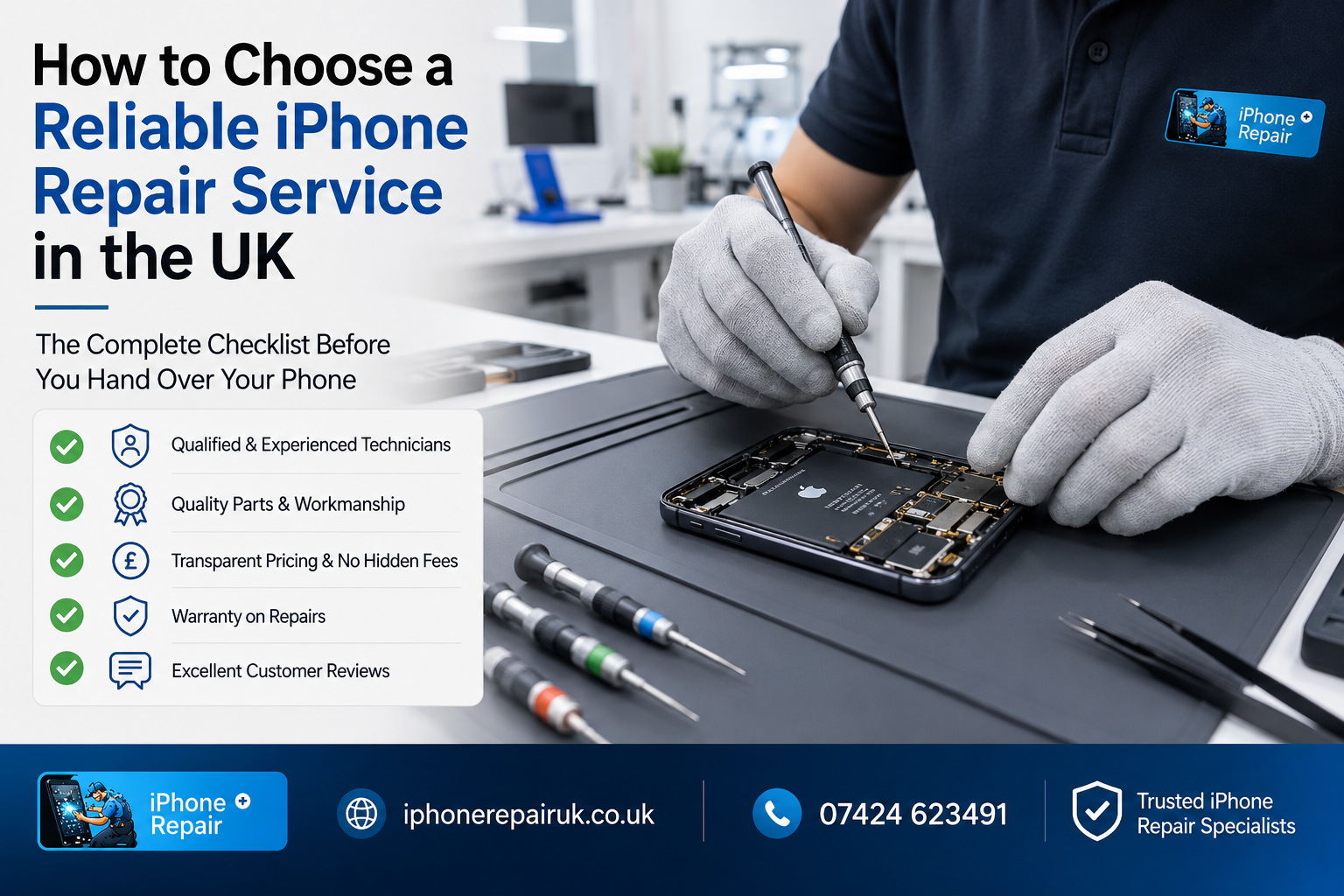
Before you book a repair, every shop you consider should pass these basic tests. If a shop fails any of them, walk away.
Clear, Transparent Pricing
A reliable repair shop publishes its prices openly, either on its website or on a board inside the premises. The price you see should be the price you pay, with no surprise additions once the phone is opened. Beware shops that quote one price by phone and a different price in person, or that add unexplained diagnostic fees to the final invoice.
A Physical Address You Can Find on a Map
A trustworthy repair business has a real, visitable location. You should be able to find it on Google Maps, see it on Street View, and walk in during business hours without an appointment. Mobile-only repairers can be excellent, but a complete absence of any fixed location is a warning sign.
A Trading Name That Matches Across All Platforms
The shop’s name on its website, its Facebook page, its Google listing, its receipts, and its signage should all match. Shops that operate under multiple shifting trading names often do so to escape negative reviews from unhappy customers.
Real Customer Reviews on Independent Platforms
Google reviews, Trustpilot, and Facebook recommendations are far harder to fake than reviews on a shop’s own website. A reliable shop has dozens or hundreds of reviews accumulated over years, with mostly positive ratings and a few honest negatives that have been responded to professionally.
Visible Technicians Actually Doing Repair Work
When you walk in, you should see the workshop area, the technicians, the tools, and the parts. A repair shop that hides its workshop is often hiding the fact that there is no workshop, because the phones are being shipped elsewhere for repair with a markup added.
A Meaningful Warranty
Any reputable shop offers a warranty on parts and workmanship. Six months is standard for most repairs and some shops offer twelve. A no warranty policy or a warranty that excludes everything that could plausibly go wrong is a red flag.
If a shop you are considering passes all six of these tests, you can move on to the more detailed evaluation. If it fails any of them, keep looking.
Questions to Ask Before You Hand Over Your Phone
A confident, competent repair shop welcomes detailed questions because the answers separate them from cheaper, less reliable competitors. A shop that gets defensive when asked basic questions is almost always one to avoid.
What Parts Do You Use and Where Do They Come From?
The answer should include some level of detail about quality grades, sourcing, and whether genuine, refurbished, or aftermarket parts are being offered. We use the best parts is not an answer. It is a marketing slogan.
What Is the Warranty and What Does It Cover?
Ask for the warranty terms in writing. A reliable shop will provide them on a printed slip or by email without hesitation.
How Long Will the Repair Take?
A good shop gives a realistic estimate based on the model, the fault, and current workload. Same-day repairs for common issues should be standard for an iPhone specialist.
What Happens If Something Goes Wrong During the Repair?
Ask explicitly. The right answer involves the shop taking responsibility, communicating clearly, and either fixing the additional issue at no charge or explaining transparently what is and is not covered.
Do I Need to Do Anything Before I Bring the Phone In?
A reliable shop will advise you to back up the phone, sign out of Find My iPhone if necessary, and remove cases or screen protectors. Shops that do not mention any of this either assume too much or care too little.
Will My Data Be Safe?
A professional repair almost never affects user data, but the answer should still be a clear, confident yes, with an explanation of how data is protected during the repair.
Can I See a Price List Before I Commit?
The answer should be yes, immediately, no hesitation. If the shop answers all of these clearly and confidently, that is an extremely good sign. If they hedge, deflect, or suggest the questions are unreasonable, find another shop.
Reading Reviews Properly
Online reviews are powerful but only if you read them properly. Most people glance at the star rating and stop there. A more useful approach takes ten minutes and tells you far more.
Start by looking at the overall rating, but treat it as one data point among many. A shop with a 4.9 from twelve reviews is much less reliable than a shop with 4.6 from five hundred. Volume matters more than perfection.
Read the negative reviews first. Every business has them. What you are looking for is the pattern. Are the negatives about minor things like waiting times, or about serious things like phones returned in worse condition than when they arrived? Are the same complaints repeating across multiple reviewers, or are they isolated incidents? Did the business respond, and how?
The way a business handles bad reviews tells you almost everything you need to know about how they will treat you if your repair has a problem. Defensive, dismissive, or attacking responses are major red flags. Calm, factual, problem-solving responses are exactly what you want to see.
Watch out for review patterns that look fake. Bursts of five-star reviews on the same day, reviewers with only one review ever, reviews that read like marketing copy rather than customer feedback, and reviews that mention the shop name unnaturally many times. Most fake reviews are obvious once you start looking.
Compare across platforms. A shop with glowing reviews on Trustpilot but mediocre Google reviews is worth a closer look, because Trustpilot reviews are easier to manipulate. Genuine quality shows up consistently across multiple independent platforms.
The Parts Question: Genuine, Refurbished, OEM and Aftermarket
The single biggest variable in iPhone repair quality is the parts being used. Understanding the different grades helps you make informed decisions about what you are actually paying for.
Genuine Apple Parts
Sourced directly from Apple, these are identical to the parts used during manufacturing. They are the highest quality option but also the most expensive, and access is limited to authorised service providers and Apple itself.
Original Pulls or Refurbished Parts
These are genuine Apple parts that have been removed from another iPhone, often one with a different fault, and refurbished. Quality is high, often indistinguishable from new genuine parts, but provenance matters. A reputable refurbisher tests every part before resale.
OEM Parts
Original Equipment Manufacturer parts come from the same factories that supply Apple, often using the same components, but sold outside Apple’s official channels. Quality varies and the best OEM parts are excellent while the worst are mediocre.
High-Quality Aftermarket
Made by reputable third-party manufacturers to specifications that closely match Apple’s, but not produced in Apple’s supply chain. Good aftermarket parts work well and cheap ones cause problems.
Generic Aftermarket
Made by unknown manufacturers, often dramatically cheaper, and frequently the source of post-repair problems like display issues, battery degradation, and component failures.
A reliable repair shop will tell you which grade of part they use as standard, will offer different grades at different prices if you ask, and will be honest about the trade-offs. A shop that uses only generic aftermarket parts but charges as if they were genuine is a shop to avoid.
The Walk-In Test
If at all possible, visit the shop in person before booking a repair. A five-minute walk-in tells you more than an hour of online research. Pay attention to the cleanliness and organisation of the workspace. Check whether you can see technicians actually working on phones. Look at the quality of the tools visible including proper screwdrivers, magnifying lamps, anti-static mats, and soldering equipment. Notice the way staff speak to other customers and whether the shop feels rushed and chaotic or calm and competent. Check whether prices are clearly displayed and take note of the general atmosphere, which usually reflects the standards of the work.
A confident, well-run repair shop welcomes walk-ins because they have nothing to hide. A shop that seems uncomfortable when you arrive unannounced is almost always a shop with something to hide.
Specific Scenarios and What to Look For
Different repairs come with different specific concerns. Here is what to look for when bringing in particular issues.
Screen Replacement
Ask whether True Tone will continue to work after the repair. On iPhones from 8 onwards, True Tone requires a factory-paired display or specialist programming. A shop that knows this will mention it and a shop that does not is using cheaper parts or skipping calibration.
Battery Replacement
Ask what battery brand they use and whether the new battery will show up in iOS Battery Health. Genuine and high-quality replacement batteries should report capacity correctly. Cheap batteries either show no data or show inflated figures.
Charging Port Replacement
Ask whether they replace the whole flex cable assembly or just the port itself. Whole-assembly replacement is more reliable but slightly more expensive.
Camera Repair
Ask whether they replace the lens cover only or the full module, and how they decide which is needed. A shop that always recommends full module replacement may be upselling.
Water Damage Repair
Ask about their cleaning and testing process. Proper water damage repair involves complete disassembly, ultrasonic cleaning, component-level inspection, and full functional testing afterwards. A shop that just dries the phone out and hopes for the best is not equipped for this work.
Logic Board Repair
Ask whether they have micro-soldering equipment and what training the technician has. Logic board work is a specialised skill that not every shop has, and the wrong hands can permanently destroy a phone.
For all of these scenarios, our iPhone & iPad repair experts in Newport bring the diagnostic equipment, the parts inventory, and the experience to give you accurate, honest advice rather than an upsell.
Red Flags That Should Send You Walking
Some signals are reliable enough that they justify walking out, even if everything else seems acceptable.
Prices that seem dramatically lower than the rest of the market are a serious warning sign. The phone industry has narrow margins on parts and if one shop is half the price of every other, they are either cutting corners or planning to add charges later.
Pressure to commit immediately is another major red flag. Reliable shops give you the information and let you decide. Shops that try to rush you, scare you, or use limited-time offers to force a decision are using sales tactics rather than confidence in their work.
Reluctance to provide written quotes means a verbal quote is worth nothing in a dispute. Vague or evasive answers about parts, warranty, or process should send you looking elsewhere. A shop that asks for full payment upfront before any diagnostic work has been done is another warning sign, as is refusal to let you watch the repair without a clear explanation of why.
A long history of trading name changes, particularly when each new name has only a handful of glowing reviews, is a pattern worth investigating. Negative reviews mentioning the same specific problem repeatedly, such as phones returned with new issues, customers being blamed for pre-existing damage, or refusal to honour warranties, should be taken seriously.
Walking away from a bad shop costs you nothing but time. Staying with a bad shop can cost you the price of a new phone.
What Reliable Repair Shops Do That Others Skip
Beyond the basics, the very best UK repair shops differentiate themselves through small details that signal genuine professionalism. They take photos of the phone before any work begins, documenting its condition for your protection and theirs. They show you the damaged part after replacement so you can see what was wrong. They calibrate sensors, screens, and Face ID where appropriate rather than just plugging in new parts. They test water resistance after repairs that affect the seal where the equipment exists to do so.
They offer collection or call-out services for customers who cannot easily visit. They explain what could go wrong before they start so there are no surprises afterwards. They keep records of repairs so they can find your details if you come back months later under warranty. They offer realistic timeframes rather than impossibly fast promises that mean rushed work. These details add up. A shop that does all of them is a shop that takes its work seriously.
Local Versus National Versus Authorised Service
The UK iPhone repair market includes three main types of provider and each has trade-offs.
Local independent shops offer fast turnaround, competitive prices, and direct relationships with the technicians who do the work. The best local shops match or beat any national or authorised service for quality. The worst local shops are some of the worst options on the market. Quality varies enormously, which is why this checklist matters.
National chains offer consistent processes, recognisable branding, and predictable pricing. They tend to be slightly more expensive than the best local shops and slightly less personal, but the quality floor is usually higher than the worst local shops.
Apple Authorised Service Providers and Apple itself offer genuine parts, factory calibration, and the strongest warranty. They are the most expensive option, often the slowest, and may decline to repair phones with previous third-party work, but they offer the highest quality assurance.
The right choice depends on your priorities. For most repairs, a well-chosen local independent specialist offers the best combination of speed, price, and quality. You can browse our comprehensive repair services to see how a quality independent shop structures its offering.
Special Considerations for Mail-In and Call-Out Services
If you are using a mail-in or call-out service rather than walking in, additional precautions apply. For mail-in services, ensure the company provides tracked, insured postage in both directions, gives you a clear deadline for the repair, sends progress updates, and has a clear policy for what happens if the phone arrives damaged in transit. Pack the phone properly, back up your data first, and remove anything that might come loose during shipping.
For call-out services, verify the technician’s identity before letting them into your home or workplace. Confirm pricing in writing before they arrive. Ensure they bring all the equipment they need including proper lighting and a clean working surface. Watch the work being done, ideally from a respectful distance, both for security and to confirm what you are paying for. Both options are perfectly valid when used with a reliable provider. The challenge is verifying reliability when you cannot walk into a workshop.
Making the Final Decision
After all the research, the comparison, and the questions, you still have to choose. Here is a final framework that helps clarify the decision.
Rank your priorities. Are speed, price, quality, and warranty equally important to you, or is one of them the deciding factor? A shop that excels at one priority may be only adequate at another, and there is no single best option for every customer.
Trust your instincts about the people. The conversations you have, the way questions are answered, the way the workshop feels: these instincts are usually right. If something feels off, find another shop.
Compare quotes from at least two shops, but do not automatically choose the cheapest. Compare value, not price. The cheapest quote often becomes the most expensive option once mistakes have to be corrected.
Confirm the repair details in writing before you commit. Price, parts, timeframe, warranty. If the shop will not put it in writing, the shop will not honour it later.
If you are based anywhere within reach of South Wales and you want to skip the comparison process entirely, you can request a free quote today and let us walk you through every detail of the repair before you commit to anything. A reliable mobile repair near me search should always end with a shop that respects your time, your money, and your phone, and it costs nothing to find out whether we are that shop for you.
A Phone Worth Choosing Carefully For
Your iPhone is one of the most expensive things you carry every day, and one of the most personal. The decision about who fixes it, when something goes wrong, deserves more than a five-second Google search and the first shop with the lowest price. Use this checklist. Ask the questions. Read the reviews properly. Visit the shop if you can. Compare value, not just price. The right repair shop will treat your phone the way you would treat it yourself, and the wrong one will cost you more than the repair would have if you had walked away. A few minutes of careful evaluation, before you hand the phone over, is the simplest way to make sure the repair you pay for is the repair you actually get.