You go to capture a moment — your kid’s first steps, a night out, a receipt you need for work — and the photo comes out soft, smeared, or hazy. Or you flip the phone over and find the rear camera glass has shattered into a tiny spider’s web. Either way, the first fear is the same: that the camera is gone and the whole phone needs replacing. It almost never does. The vast majority of iPhone camera problems are fully repairable without buying a new handset, and many are far cheaper to fix than people expect. The trick is understanding what has actually failed — because with iPhone cameras, the difference between a small repair and a larger one comes down to one specific thing that most people have never had explained to them.
This guide clears that up. We will walk through what your camera is really made of, what each common fault means, how a technician works out which repair you need, and what it realistically costs — so you can stop worrying and make an informed decision.
Camera Problems Are More Common — and More Fixable — Than You Think
iPhone cameras take a lot of punishment. They sit in a raised bump on the back of the phone, which means they are usually the first thing to hit the ground in a face-up drop. They are exposed to pocket grit, dust, and moisture. And the technology packed into them — multiple lenses, stabilisation motors, autofocus systems — is delicate by nature. So camera faults are genuinely common, and we see them constantly.
The reassuring part is how repairable they are. Because the camera is a self-contained assembly that can be removed and replaced independently, you do not need to scrap an otherwise perfect phone over a camera issue. In most cases the rest of the device is completely fine — it is one component that needs attention, and replacing or repairing that one component is straightforward work for a technician. Our dedicated iPhone camera and lens repair service handles all of these faults, and the page goes into the specifics of the process.
The Most Important Thing to Understand: Lens Glass Versus the Camera Module
If you take one thing from this entire article, make it this. When people say “my iPhone camera is broken,” they are usually describing one of two very different things, and the distinction is the single biggest factor in what your repair costs.
The Outer Lens Glass
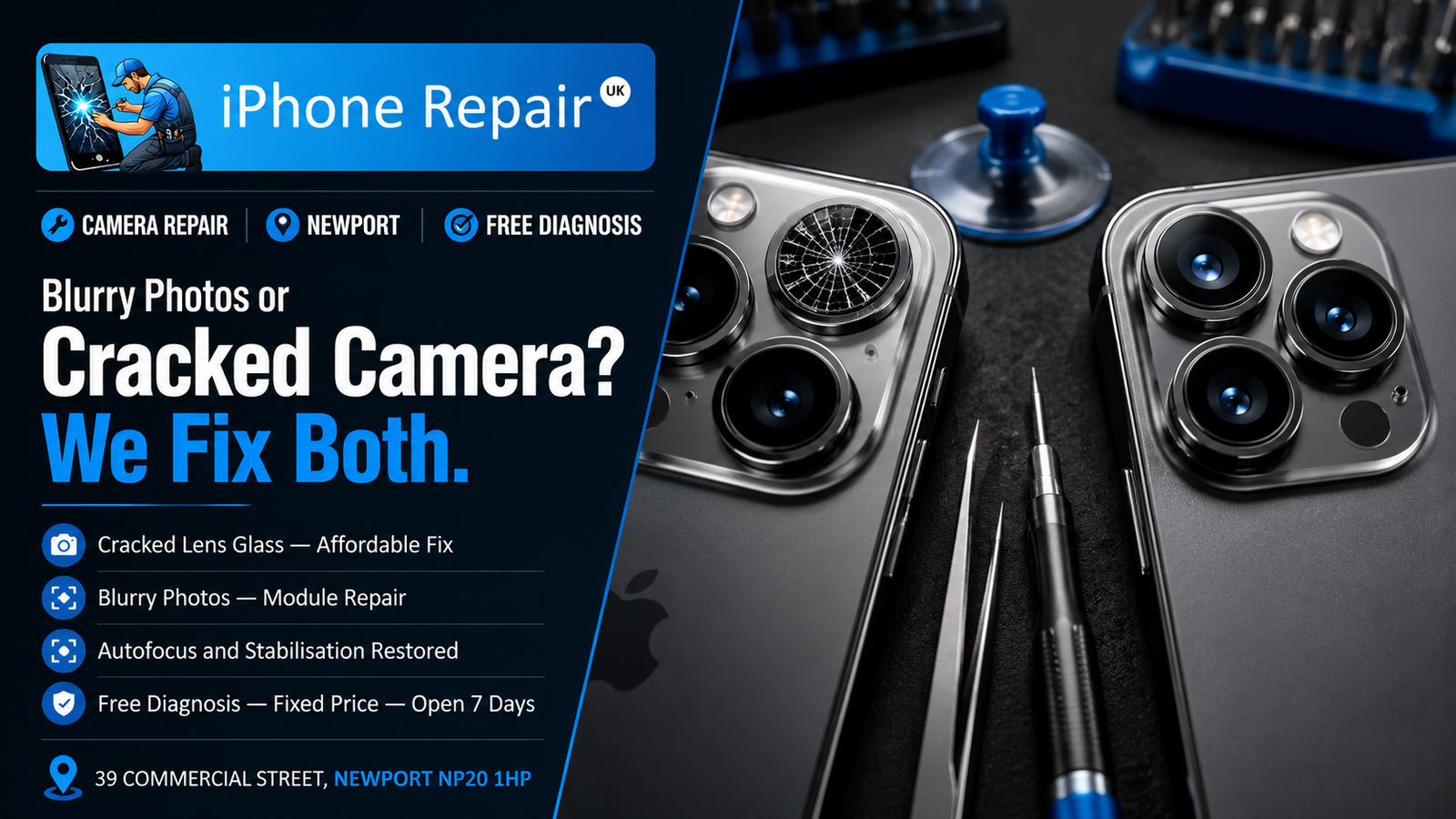
On the back of your iPhone, each camera sits behind a small, round piece of protective glass. This is the outer lens glass — and it is not the camera itself. It is a clear cover that protects the actual camera underneath, a bit like a watch face protecting the watch. When you drop your phone and crack the camera, what has usually shattered is this protective glass cover. The real camera behind it is frequently untouched and still working perfectly.
Replacing just the outer lens glass is one of the more affordable and quicker camera repairs, because you are swapping a small protective cover rather than the expensive camera assembly. This is why it matters so much to identify the fault correctly: a cracked lens glass is often a modest fix, not a major one.
The Camera Module
The camera module is the actual camera — the image sensor, the stack of internal lenses, the autofocus and stabilisation motors, and the flex cable that connects it all to the phone. This is the complex, costlier part. When the module itself fails — the camera cannot focus, photos are blurry even though the glass is clean, the camera app shows only a black screen, or you can hear a rattle from inside — then the whole module needs replacing rather than just the glass.
A module replacement costs more than a lens glass repair because the part itself is far more sophisticated. But — and this is the key point — it still costs a small fraction of replacing the entire phone.
Why This Distinction Drives the Price
Here is the practical upshot. Two people can walk in saying exactly the same thing — my iPhone camera is broken — and leave with very different quotes, because one needs a simple lens glass replacement and the other needs a full module. Neither is being treated differently; they genuinely have different repairs. A trustworthy shop will always tell you which one you are looking at and why, rather than quoting the expensive option by default. That honest diagnosis is exactly what protects you from overpaying.
Common iPhone Camera Faults and What Causes Them
Camera issues show up in a handful of recognisable ways. Here is what each one usually means.
Cracked Rear Lens Glass
The classic drop-damage fault. The protective glass over one or more rear cameras shatters, while the camera underneath often still works. Beyond looking bad, cracked lens glass causes real problems: light scatters off the broken glass and ruins your photos with flares and haze, and tiny glass fragments and dust can work their way inside toward the camera. That is why it is worth fixing promptly rather than living with it — a cracked cover left alone can turn a cheap glass repair into a module problem.
Blurry Photos Despite a Clean Lens
One of the most frustrating faults, because everything looks fine on the outside. If your photos are consistently soft or smeared and the glass is clean and undamaged, the cause is usually internal. It might be debris that has crept inside the assembly, a failed autofocus, or — very commonly — a damaged optical stabilisation system. Many iPhones use stabilisation to keep shots sharp, and if that mechanism is knocked out by a drop, photos come out blurry or shaky. Sometimes you can even hear a faint rattling from the camera when you tap the phone, which is a strong clue the stabilisation has been damaged.
There is also a surprisingly common, completely free fix worth ruling out first: strong magnets. Some magnetic phone cases, car mounts, and accessories sit right over the camera, and powerful magnets can interfere with the camera’s stabilisation, causing blur and shake. If your blurriness started after adding a magnetic accessory, removing it is the first thing to try.
Autofocus Failure
If the camera constantly hunts in and out and never locks onto a sharp image, or seems stuck at one focus distance, the autofocus system is likely at fault. This usually points to the camera module and is corrected by repairing or replacing it — though, as above, it is always worth checking that a magnetic accessory is not the culprit.
Black Screen in the Camera App
You open the camera and the preview is just black, or it freezes. This can be a hardware fault in the module or its connection, but it can also be a software glitch. Because the cause is not obvious from the symptom alone, this is exactly the kind of fault that needs a proper diagnosis — sometimes it is resolved on the software side, and sometimes the module genuinely needs replacing.
Front Camera Issues
The front selfie camera can also fail — producing blurry self-portraits, a black screen on video calls, or problems with Face ID, which relies on the front sensor array. Front camera faults are sometimes linked to screen damage, since the front camera sits at the top of the display assembly, so a diagnosis will check whether the two are connected.
Dust or Condensation Trapped Under the Lens
If you see specks, spots, or a foggy haze that no amount of wiping removes, you may have dust or moisture trapped inside the camera. Condensation in particular often appears after a phone has been exposed to water, steam, or damp — and that is an important signal, because it can point to a wider moisture problem inside the phone, not just the camera.
How We Diagnose a Camera Fault
A good camera repair starts with working out which of the above is actually happening, and that is quicker than you might think. When you bring your iPhone in, a technician will examine the lens glass and the camera assembly, test the camera across its functions — focusing, switching between lenses, capturing photos and video, checking the flash and the front camera — and look for the tell-tale signs that separate a glass-only issue from a module fault. We will check the obvious free fixes first, such as a magnetic accessory or a dirty protector, before recommending any paid work.
The goal of the diagnosis is to answer one question clearly: is this a lens-glass repair or a module replacement? Once we know that, we can give you a straight explanation and a fixed price. The diagnosis itself is free, so you are never paying just to find out what is wrong. For a deeper look at the most common cracks and blur problems and how they are resolved, our article on iPhone camera lens cracks, blur and fixes is a useful companion to this guide.
What iPhone Camera Repairs Realistically Cost
Exact prices change over time and vary by model, so rather than quote figures that might be out of date, here is the honest framework that determines what you will pay.
The biggest factor, as we have explained, is whether you need a lens glass repair or a full module replacement. A lens glass repair sits at the affordable end, because it is a small protective cover. A camera module replacement costs more, because the part is far more complex. Front camera repairs fall somewhere in between. On top of that, your model matters: newer iPhones with multiple rear lenses and advanced stabilisation use pricier camera modules than older single-lens models, so the same repair costs more on a recent Pro than on an older standard iPhone.
What stays constant across all of this is the value comparison. Even a full module replacement on a recent model is a fraction of the cost of replacing the phone, and a lens glass repair is cheaper still. We give you a free diagnosis and a fixed price for your exact model and exact fault before any work begins, and you only pay once it is done. If you want a broader sense of how repair pricing works across all iPhone faults, our overview of what to expect from a same-day repair in Newport sets out the wider picture.
Before and After: What a Cracked Lens Does to Your Photos
It helps to understand exactly how a damaged camera shows up in your actual photos, because the change after a repair can be dramatic.
With a cracked lens glass, light entering the camera hits the broken glass and scatters in every direction. The result is photos plagued by glare, washed-out hazy patches, bright streaks across the image, and a general loss of contrast and sharpness — especially noticeable in bright light or at night around streetlights. It can look as though a permanent foggy filter has been applied to everything. With a failed stabilisation system or autofocus, the symptom is different: images that are simply soft and blurred no matter how steady you hold the phone.
After the correct repair, the change is immediate and obvious. Replace the cracked glass and the scattering stops — photos return to crisp, clear, glare-free images. Replace a faulty module and focus and stabilisation are restored, so shots are sharp again. People are often genuinely surprised by how much sharper their photos look afterwards, because the decline was gradual enough that they had stopped noticing just how degraded their pictures had become.
Which iPhone Models Have the Most Camera Issues — and Why
Some models come in for camera repairs more than others, and there is a clear reason. As iPhones have advanced, their rear camera systems have grown larger and more prominent — the camera bump on a modern Pro model protrudes noticeably from the back of the phone. That raised bump is exactly what makes contact first in a face-down drop, which is why newer, larger-camera models see more cracked lens glass.
At the same time, the Pro and Pro Max models pack the most lenses and the most advanced stabilisation, so their camera modules are the most complex and the costliest to replace. Older and standard models, with fewer lenses and simpler systems, tend to have less exposed cameras and lower module costs. None of this should put you off owning the camera you want — it simply explains why a free diagnosis matters, so you know precisely what your specific model needs.
When a Camera Fault Signals Deeper Damage
Occasionally, a camera problem is not really about the camera at all — it is the visible symptom of something larger, and a responsible repair shop will flag this rather than just swap a part.
Two situations are worth watching for. The first is drop damage: if your camera fault appeared right after a heavy fall, the same impact may have affected the screen, the internal connectors, or other components, so it is wise to have the whole device checked rather than assuming the camera is the only casualty. Drop impacts often affect the screen and front assembly at the same time. The second is moisture: condensation or fogging inside the camera frequently indicates that liquid has got into the phone, which can quietly corrode other components over time. In that case the camera is a warning light for a wider problem, and a water damage assessment is the sensible next step. We will always tell you if we think your camera fault points to something broader.
iPhone Camera Repair FAQ
How much does iPhone camera repair cost?
It depends on whether you need a lens glass repair or a full camera module replacement, and on your model. Lens glass repairs are the most affordable; module replacements cost more because the part is more complex; newer models with multiple lenses sit at the higher end. We give a free diagnosis and a fixed price for your exact phone before any work starts, and in every case it is far cheaper than replacing the device.
How long does an iPhone camera repair take?
Most camera repairs are same-day jobs, and many are completed quickly once we have the right part in stock. A less common model may need a part ordered in, which can add a little time. We will tell you the expected turnaround at the point of diagnosis.
Can you fix just the glass, or do you have to replace the whole camera?
Often we can fix just the outer lens glass, which is the cheaper repair, as long as the camera module beneath is still working properly. If the module itself has failed — blur with a clean lens, dead autofocus, a black camera screen — then the module needs replacing. The free diagnosis tells us, and you, exactly which one applies.
Is a blurry camera always a hardware fault?
No. Before assuming hardware, it is worth ruling out a few things: a dirty or greasy lens, a thick or low-quality screen protector overlapping the camera, a software glitch that a restart can clear, or a magnetic accessory interfering with stabilisation. If none of those is the cause and the lens is clean, then it is likely an internal fault we can repair.
My front camera and Face ID stopped working — can you fix that?
Yes. Front camera and Face ID faults are repairable, and because the front camera sits within the screen assembly, our diagnosis will check whether the issue is the camera itself or related to screen damage.
Bring Your iPhone In for a Free Camera Diagnosis
A blurry photo or a cracked lens is annoying, but it is rarely the disaster it first seems. Most iPhone camera faults are fixable, the repair usually costs a fraction of a new phone, and in many cases it is the small, affordable lens glass — not the whole camera — that needs attention. The only way to know for sure which repair you need is to let a technician take a proper look and tell you straight.
If your iPhone camera is cracked, blurry, or not behaving, bring it to iPhone Repair UK at 39 Commercial Street, Newport, NP20 1HP. We are open Monday to Saturday from 9:00 AM to 6:00 PM and Sunday from 11:00 AM to 4:00 PM, the camera diagnosis is free, and you only pay once the repair is complete. Call or WhatsApp us on 07424 623491, or request a free quote through our contact page and tell us what your camera is doing. We will work out whether it is the glass or the module, give you an honest price, and get you back to taking sharp photos again.