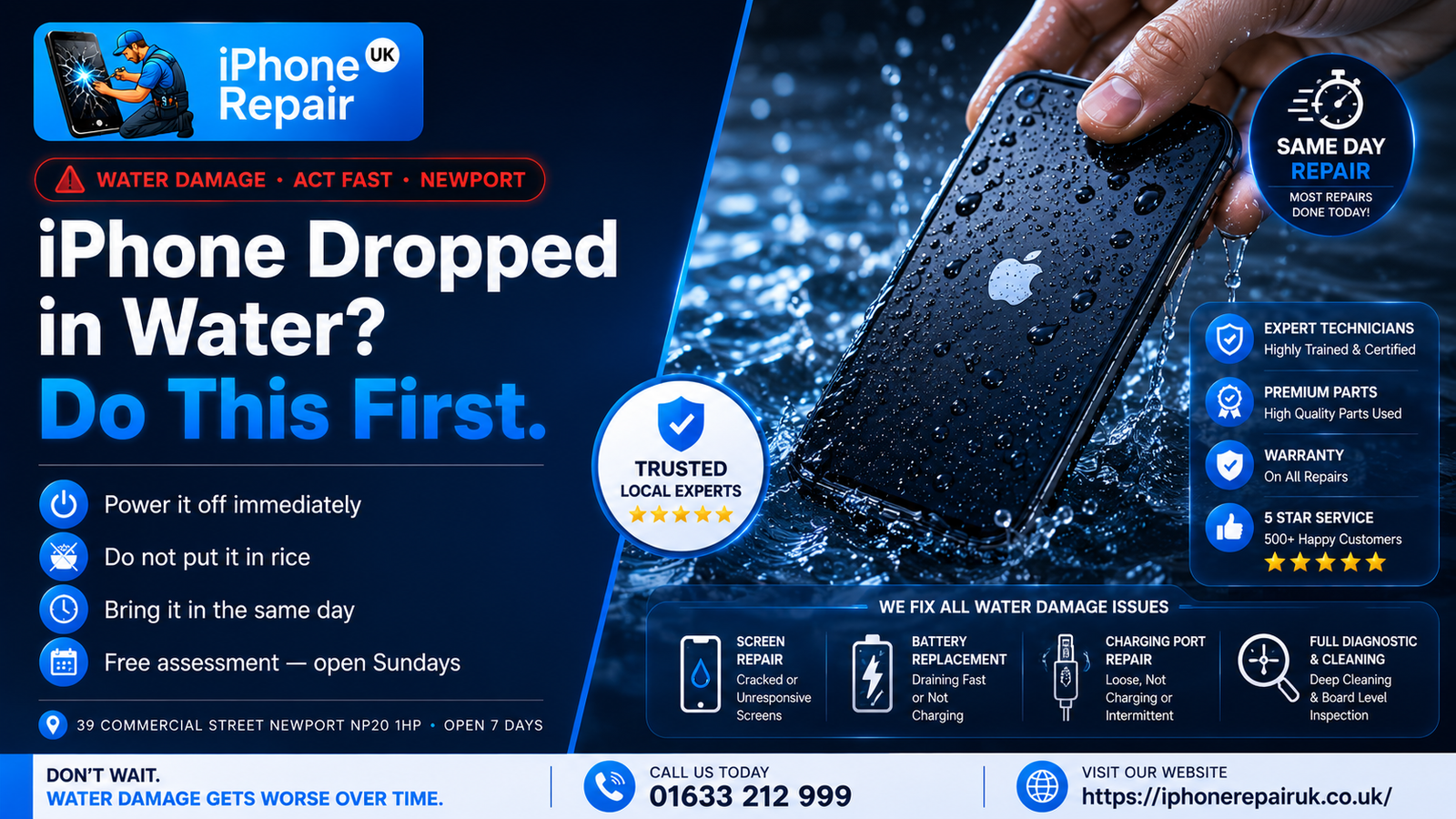
If your iPhone is wet right now, do this first. Get it out of the water immediately. Turn it off do not check it, just power it down. Do not press any buttons. Do not plug it in to charge. Wipe the outside dry with a cloth or towel. Hold it upright and gently shake water out of the charging port and speakers, screen facing down. Remove the SIM tray to help it vent. Then leave it switched off and bring it to a repair technician as soon as you possibly can. The faster a professional opens and dries it, the better your chances. Now take a breath the steps below explain everything in order.
That opening is the part that actually saves phones, so read it twice if you need to. Everything else here is the detail behind it: what to do minute by minute, why the famous rice trick is a myth, the difference between water-resistant and waterproof, and what really happens when we recover a water-damaged iPhone here in Newport.
The First 60 Seconds: Power Down and Get It Dry
The single most important thing in the first minute is to cut the power. Water and electricity do not mix, and an iPhone that is still switched on while wet inside can short-circuit that is when a recoverable accident becomes a dead phone.
So, in order: lift it out of the water straight away because seconds count. Switch it off and if it is already off, leave it off and do not turn it on just to check. Dry the outside with a towel, cloth, or your sleeve. Hold it with the screen facing down and gently encourage water out of the ports. Pop out the SIM tray so the inside can breathe.
The reason to power down rather than poke around is simple. Every tap on the screen, every button press, every is it still working risks pushing current through wet circuitry. A phone that is off and wet is in a holding pattern. A phone that is on and wet is actively at risk.
The First 10 Minutes: Stop Helping It Dry the Wrong Way
Once the phone is off and the outside is dry, the instinct is to do something anything to speed up drying. This is exactly where most people go wrong.
Do not shake it violently, blast it with a hairdryer, leave it on a radiator, or put it in the airing cupboard. Heat and force do not help. They drive moisture deeper into the device and can damage components that the water alone might have spared. Set the phone down somewhere dry, at room temperature, screen-side down on a towel, and leave it alone.
If the phone went into something other than clean water the sea, a toilet, a sugary drink, a puddle that matters too. Salt water and dirty water are far more corrosive than tap water, and sugary liquids leave a sticky residue that attracts moisture and gums up connectors. You cannot fix this at home, but knowing it helps a technician treat the phone correctly, so mention it when you bring it in.
The First Hour: Get It to a Technician
Here is the honest truth the internet rarely tells you: there is very little you can usefully do at home beyond keeping the phone off and dry. The clock that matters is the corrosion clock, and it starts ticking the moment liquid reaches the inside of your phone.
The best possible move within the first hour is to get the device to someone who can actually open it, properly clean the internal corrosion, dry it under controlled conditions, and test it. That is not a job for a kitchen table. The sooner that happens, the more of your phone and your photos, messages, and contacts can be saved. Our full step-by-step on what to do when an iPhone is dropped in water covers this in even more detail, and our water damage repair service page explains exactly how we treat it.
Why the Rice Trick Doesn’t Work and Actually Makes Things Worse
Almost everyone has heard it: drop your wet phone in a bag of rice overnight and it will be fine. It is one of the most persistent pieces of bad advice around, and it costs people their phones.
Here is the science, kept simple. Rice is a mediocre desiccant it absorbs some moisture from the surrounding air, slowly. But your phone’s water problem is not on the surface; it is sealed inside, around the logic board and connectors, where a few grains of rice and a paper bag have no meaningful reach. While the rice is working, two bad things are happening. First, the water already inside is sitting against metal contacts, and corrosion is forming the entire time minerals and salts in the water react with the components and begin eating away at them within hours. Second, rice sheds starch and dust, and small grains and powder can lodge in the charging port and speaker mesh, creating a second problem on top of the first.
So the rice trick fails twice over. It does not dry the part of the phone that matters, and it wastes the most valuable hours you have the early window when professional cleaning could have prevented permanent corrosion. The phone often appears to work for a day or two afterwards, which is why people swear by it, and then fails later as corrosion spreads. By that point the damage is far harder and more expensive to reverse.
What NOT to Do (A Quick, Clear List)
If you remember nothing else, remember these. Do not charge it. Plugging in a wet phone sends current through wet circuitry and is one of the fastest ways to kill it. Wait until it has been professionally checked. Do not press buttons repeatedly or keep waking the screen because every press risks a short. Do not use a hairdryer, oven, microwave, or radiator because heat pushes moisture inward and warps delicate parts. Do not put it in rice because it does not reach the problem and adds debris. Do not shake it hard because gentle is fine but aggressive shaking spreads water around inside. Do not assume it is fine because it switches on because a phone working on day one can fail on day three as corrosion takes hold.
Water-Resistant Is Not Waterproof: Why Even Newer iPhones Still Get Damaged
Modern iPhones come with an IP rating you will see figures like IP67 or IP68 quoted by Apple and many owners take this to mean their phone is waterproof. It is not, and the distinction is the reason we still recover water-damaged water-resistant phones every single week.
Water resistance is tested in controlled laboratory conditions, in clean, still, fresh water, on a brand-new device, for a limited time and depth. The real world is none of those things. Three factors quietly erode that protection.
First, the seals age. The adhesive gaskets that keep water out degrade over time, and they are routinely disturbed the first time a phone is opened for any repair, including a screen replacement. An eighteen-month-old phone is nowhere near as sealed as it was on day one.
Second, the conditions are wrong. Salt water, soapy bath water, chlorinated pools, hot showers, and pressurised water all defeat seals far more easily than the gentle lab test. Steam is a particular culprit fine water vapour from a hot shower or bath finds its way in where a quick splash might not.
Third, the rating is a maximum, not a promise. It describes the best case for a pristine device, not a guarantee for your specific, used phone in your specific accident.
This applies right across the range, including compact models. People often assume a smaller phone like the iPhone SE is somehow tougher or less exposed, but a wet iPhone SE needs exactly the same urgent care as any other model power it down, keep it dry, and get it assessed quickly. No iPhone is genuinely waterproof, and treating any of them as if they are is how accidents become disasters.
What Professional Water Damage Assessment Actually Involves
When you bring a water-damaged iPhone to us, the work is methodical, not a guess. Here is what genuinely happens behind the counter.
The Diagnosis
We start by opening the device in a controlled way and inspecting the internal condition. Liquid leaves clues corrosion bloom on connectors, residue on the board, telltale discolouration, and tripped liquid contact indicators. This inspection tells us where the water went, how far it spread, and which components have been affected. Crucially, it tells us whether we are dealing with light surface moisture or established corrosion, and that shapes everything that follows. The assessment is free, so you get a clear, honest picture before deciding anything.
The Components Most Commonly Affected
Water does not damage a phone evenly. The parts we see suffer most often are the logic board and its connectors, where corrosion can interrupt the fine pathways that make the phone work. The battery, which can be damaged or begin to swell after liquid exposure. The charging port, which corrodes readily and is often the first thing to fail. The display connectors and the screen itself, which may show lines, dead spots, or discolouration. And the cameras, which can fog or fail. Knowing the usual victims means we know where to look first.
Cleaning, Drying and Testing
Once we understand the damage, the real recovery work begins. Corrosion is carefully cleaned from the board and connectors using the proper solutions and techniques this is the step rice can never do. The device is then dried under controlled conditions rather than rushed with heat. Finally, we test each component systematically to see what has survived and what needs repair or replacement. Sometimes a phone simply needs cleaning and drying and comes back to life. Sometimes the corrosion has damaged the charging port, and a charging port replacement is needed. Sometimes the battery has been compromised and should be replaced for safety. We talk you through whatever we find and quote it before proceeding.
When Water Damage Is Recoverable and When It Isn’t
We will always be straight with you about this, because false hope helps no one.
Water damage is often recoverable when the phone was retrieved quickly, switched off promptly, kept dry, and brought in within hours rather than days. In these cases the corrosion has had little time to take hold, cleaning is effective, and many phones are fully restored. The faster the response, the better the odds it really is that simple.
Recovery becomes harder, and sometimes not worth the cost, when a phone was left switched on in water, charged while wet, dried in rice for days, or simply left for a week before anyone looked at it. In those situations corrosion may have spread across the logic board, and while board-level repair can sometimes still save the device or at least recover the data, the work is more involved.
Even when a phone cannot be brought fully back to life, data recovery is frequently still possible and for most people, the photos, messages, and contacts matter more than the handset itself. So even if you fear the worst, it is worth bringing the phone in. There is often more we can save than you would expect.
Why Bringing It In the Same Day Matters So Much
If there is one message that runs through this entire guide, it is speed. Corrosion is a chemical reaction, and like any reaction it advances with time. Every hour a wet phone sits untreated, minerals and salts continue to react with the metal inside it. The repair that would have been straightforward on the day of the accident can become difficult or impossible a few days later.
This is exactly why a local repair shop is such an advantage with water damage specifically. You are not posting a wet phone across the country and adding three or four days of corrosion to the problem. You can bring it straight to us in the city centre and have it assessed the same day. For water damage, that local speed is not a nice-to-have; it is often the difference between a phone you keep and a phone you replace.
Weekend Spills Happen and We’re Open on Sundays
Here is something worth knowing before you need it: water accidents love weekends. Pools, baths, kitchens, the seaside, a relaxed drink that ends up somewhere it shouldn’t Saturday and Sunday are prime time for wet phones, and that is precisely when many people assume there is nowhere to turn until Monday.
You do not have to wait. We are open seven days a week, including Sunday from 11:00 AM to 4:00 PM, and Monday to Saturday from 9:00 AM to 6:00 PM. So if your iPhone takes an unexpected dip on a Sunday afternoon, you can bring it in the same day rather than leaving it to corrode for another twenty-four or forty-eight hours. With water damage, those saved hours genuinely count.
Quick Answers to Common Water Damage Questions
My iPhone fell in water but still works is it fine?
Not necessarily. Corrosion can take days to cause failure, so a phone that works today may fail later in the week. It is worth a free assessment to clean any internal moisture before it causes lasting damage.
Is it really worth bringing it in if it’s switched off and seems dead?
Yes. A phone that is off and dry is exactly the phone with the best recovery chances. And even in the worst case, your data is often recoverable. Bring it in.
Will my photos and messages survive?
Often, yes especially if you act quickly. Even when a phone cannot be fully restored, data recovery is frequently still possible.
How long does water damage repair take?
Longer than most repairs, because proper cleaning and controlled drying cannot be rushed. We will give you a realistic timeframe after the free assessment.
Does Apple’s water resistance rating mean I’m covered?
No. Water resistance is a controlled lab rating on a new device, not a real-world guarantee, and seals weaken with age and after any repair. Treat every iPhone as vulnerable.
Don’t Wait Bring Your Wet iPhone In Today
A water-damaged iPhone is frightening in the moment, but the right response is calm and quick: power it off, keep it dry, skip the rice, and get it to someone who can properly clean and dry it before corrosion sets in. The phones we save are almost always the ones brought in fast.
If your iPhone has been in water, bring it straight to iPhone Repair UK at 39 Commercial Street, Newport, NP20 1HP. We are open Monday to Saturday 9:00 AM to 6:00 PM and Sunday 11:00 AM to 4:00 PM, and the assessment is free. Call or WhatsApp us on 07424 623491, or message us through our contact page and head in. The sooner we see it, the more we can save so don’t leave it sitting in a bowl of rice hoping for the best. If you would like to understand the wider picture of what a same-day repair in Newport involves, we have covered that too. Right now, though, the best thing you can do for a wet phone is get it to us.