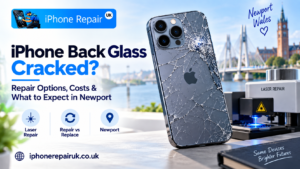
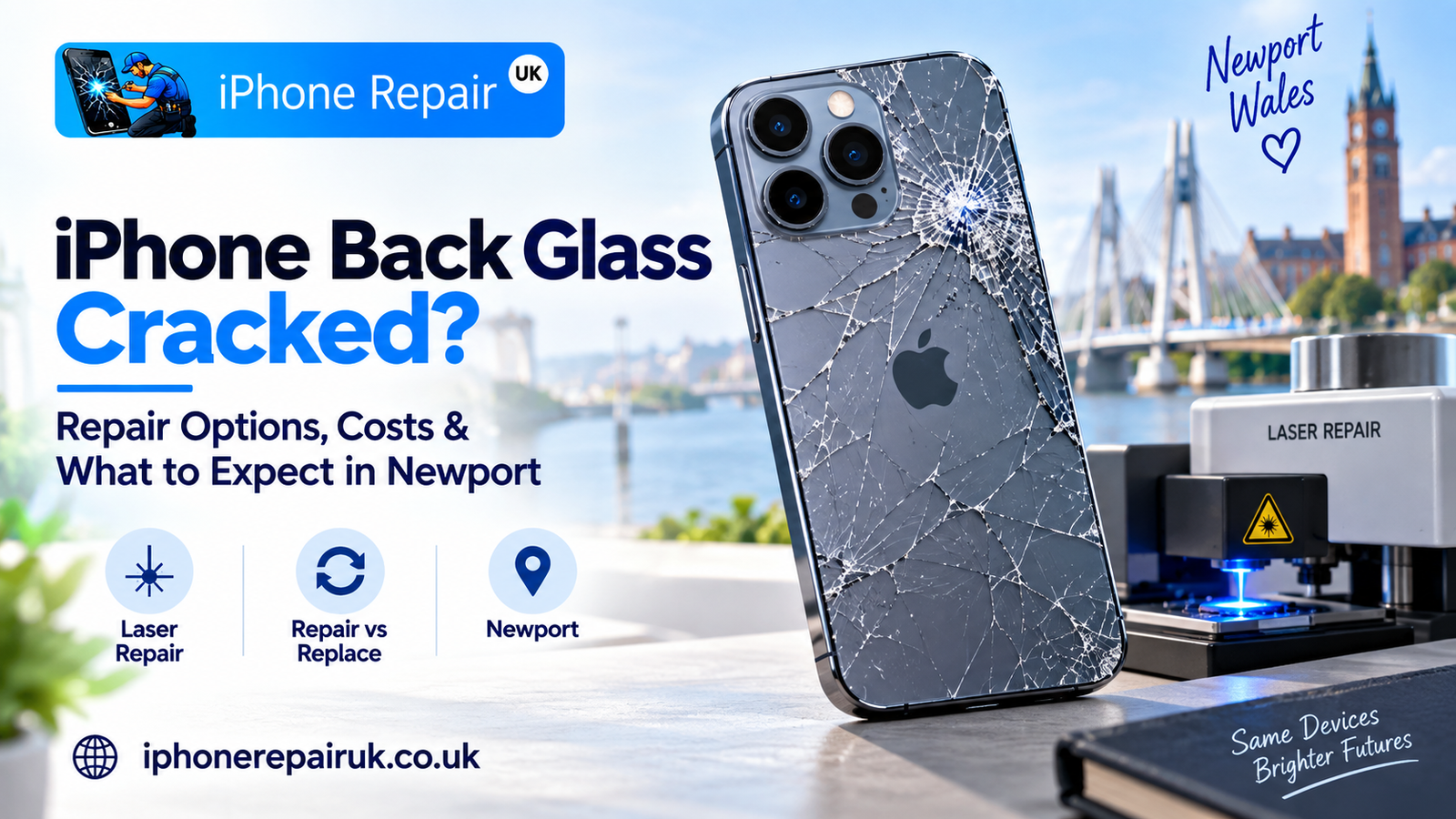
The moment you flip an iPhone over and see the back is a spiderweb of cracks, three questions arrive at once. Is it fixable? Is it worth fixing? And why does something that looks so simple cost what it costs?
The honest answers are: yes it is fixable on every glass-backed iPhone from the iPhone 8 onwards; it is usually worth fixing if you plan to keep the phone; and the reason it costs what it does is that back glass repair is genuinely one of the trickier repairs on the bench, particularly on the older models where the glass is fused to the aluminium chassis and has to be removed with a laser rather than a screwdriver.
This guide covers everything you need to know about iPhone back glass repair Newport residents will actually use: which iPhones have glass backs, how the two eras of back panel construction change what the repair involves, realistic 2026 UK cost brackets by model, when back glass repair is not cost-effective, and what a proper professional back glass replacement should include. As an Apple-only workshop in Newport, we fit back glass on iPhones from every era, and the process is quite different depending on whether we are working on a 2018 iPhone XS or a 2024 iPhone 16.
Why iPhones Have Glass Backs in the First Place
Apple switched to glass-backed iPhones with the iPhone 8 released in September 2017. Before that, iPhones from the iPhone 5 through to the iPhone 7 Plus used aluminium back panels. There is no such thing as back glass on an iPhone 7 or earlier because the back is a single machined aluminium unibody.
The reason for the switch was wireless charging. Aluminium blocks the magnetic induction that Qi wireless chargers rely on, so Apple needed a non-metallic back panel to allow inductive charging to work. Glass was the material chosen because it looks premium, does not block radio signals, and unlike plastic does not scratch or discolour with age. The tradeoff was obvious from day one: glass cracks when you drop it. A back-glass iPhone dropped face-down cracks the display; dropped back-down, it cracks the rear panel; dropped edge-first, it can crack both.
The iPhones with glass backs include iPhone 8 and 8 Plus, iPhone X, XS, XS Max, and XR, iPhone 11, 11 Pro, and 11 Pro Max, iPhone SE 2020 and iPhone SE 2022, iPhone 12, 12 mini, 12 Pro, and 12 Pro Max, iPhone 13, 13 mini, 13 Pro, and 13 Pro Max, iPhone 14, 14 Plus, 14 Pro, and 14 Pro Max, iPhone 15, 15 Plus, 15 Pro, and 15 Pro Max, and all iPhone 16 and iPhone 17 series models. Every one of these has some form of glass rear panel and can develop the cracked-back problem.
Is a Cracked Back Glass Actually a Problem?
The comfortable answer is that a cracked back is cosmetic and can be ignored. Sometimes that is true. Often it is not. Here are the real reasons to take back glass damage seriously.
Wireless charging performance can suffer because the inductive coil for MagSafe and Qi charging sits directly behind the back glass. Small cracks rarely stop wireless charging working entirely, but larger cracks or extensive spider webbing can disrupt the electromagnetic field and cause slow charging, intermittent connection, or complete charging failure through the back.
Water resistance is compromised by any crack. Every iPhone from the iPhone 7 onwards has an IP rating, and that rating depends on the back panel forming a watertight seal against the frame. Any crack breaks the seal. Rain, sweat, or an accidental splash that a healthy iPhone would shrug off can enter through a cracked back and reach the battery, logic board, and other components. The damage from that ingress is far more expensive to fix than the back glass itself.
Sharp edges cut fingers. Modern iPhone back glass is chemically strengthened, and when it fails it fails badly. Cracks develop into sharp raised shards and anyone who has held a cracked-back iPhone for more than five minutes has usually cut themselves on it.
Cracks propagate over time as the phone flexes in your pocket, in a case, or on a table. A repair now is often much cheaper than a repair in six months when the damage has spread to the camera housing. A visibly cracked iPhone is also worth roughly half what an intact one is worth on the second-hand market, so the back glass repair almost always pays for itself in resale price. On many iPhones the rear glass extends up around the camera bump and forms part of the camera housing, meaning cracks near the camera can eventually reach the lenses themselves, at which point you are looking at a much more expensive lens repair alongside the glass job.
The Two Eras of iPhone Back Glass Construction
Not all iPhone back glass is fitted the same way, and this is the single most important thing to understand about the cost of the repair. Apple redesigned the internal chassis of the standard iPhone 14 and iPhone 14 Plus to make back glass replacement dramatically simpler. Pro models kept the older, harder-to-repair design for one more generation, then adopted the easier design from the iPhone 15 Pro onwards.
Era 1: Fused Back Glass (Requires Laser Removal)
This covers iPhone 8 through iPhone 13 all variants, plus iPhone 14 Pro and iPhone 14 Pro Max, plus iPhone SE 2020 and iPhone SE 2022. On these models, the back glass is laminated directly to the aluminium or stainless steel mid-frame with a continuous layer of structural adhesive. There is no separate rear cover that clips or unscrews. To replace the glass, the old panel has to be removed without damaging the frame underneath, without displacing the wireless charging coil, without cracking the camera surround, and without disturbing the antenna lines that run along the frame.
The professional method for doing this is a laser separating machine. The laser is tuned to a specific wavelength that vaporises the adhesive layer between the glass and the metal frame without damaging either. The broken glass lifts away cleanly in fragments, the frame underneath is intact, and a fresh panel can be bonded on. The alternative is heat plus solvent plus mechanical scraping, which is what DIY guides on YouTube demonstrate and works about as often as it fails. The failures are expensive: bent frames, punctured batteries, damaged wireless charging coils, cracked camera surrounds, and cut cables. Reputable Apple workshops have moved to laser removal because the success rate is far higher and the risk to the internal components is far lower.
Era 2: Removable Back Glass (Screws and Suction)
This covers iPhone 14, iPhone 14 Plus, iPhone 15, iPhone 15 Plus, iPhone 15 Pro, iPhone 15 Pro Max, and all iPhone 16 and iPhone 17 models. Apple redesigned the standard iPhone 14 in 2022 with a new internal chassis architecture that made the rear glass panel a genuinely removable piece rather than a fused sheet. The phone now opens from both the front and the back. The back panel is held in place by two screws and a small number of connectors rather than a continuous adhesive bond, and removing it takes minutes rather than the extended laser process required on older models.
The change dramatically lowered the cost and complexity of back glass repair for these models. Interestingly, the change was applied only to standard iPhone 14 models at first; iPhone 14 Pro and iPhone 14 Pro Max kept the older fused design and correspondingly higher repair cost. From iPhone 15 Pro onwards, Apple applied the easier design to Pro models too. Note that the panel itself on the newest iPhones is more expensive than older glass because the panels are larger, more precisely tinted, and built around the camera plateau and antenna windows, so while the labour is lower the parts cost is often higher on iPhone 16 Pro and iPhone 17 Pro than on an iPhone 13 or iPhone 14 standard.
Typical UK Repair Costs by Model (2026)
The right combination of labour method and part cost produces the pricing you see across the industry. Here are rough UK market brackets for professional back glass replacement in 2026.
iPhone 8 and 8 Plus use fused laser design and typically cost £45 to £70. iPhone X, XS, and XR use fused laser design and typically cost £60 to £85. iPhone XS Max uses fused laser design and typically costs £65 to £90. iPhone 11, 11 Pro, and 11 Pro Max use fused laser design and typically cost £60 to £90. iPhone SE 2020 and SE 2022 use fused laser design and typically cost £50 to £75. iPhone 12 series uses fused laser design and typically costs £60 to £90. iPhone 13, 13 mini, 13 Pro, and 13 Pro Max use fused laser design and typically cost £60 to £95. iPhone 14 and 14 Plus use the removable panel design and typically cost £75 to £110. iPhone 14 Pro and 14 Pro Max use fused laser design and typically cost £120 to £160. iPhone 15 and 15 Plus use the removable panel design and typically cost £75 to £110. iPhone 15 Pro and 15 Pro Max use the removable panel design and typically cost £80 to £120. iPhone 16, 16 Plus, and 16e use the removable panel design and typically cost £85 to £130. iPhone 16 Pro and 16 Pro Max use the removable panel design and typically cost £120 to £160. iPhone 17 series uses the removable panel design and typically costs £75 to £250.
These are third-party specialist ranges. Apple’s own out-of-warranty back glass service is typically higher, particularly on Pro models where Apple’s process can involve full chassis replacement rather than glass-only repair. AppleCare+ dramatically reduces the direct cost if you have it. The Pro model on any generation tends to sit noticeably above the standard model. iPhone 14 Pro is the most extreme example because it kept the fused design while the standard iPhone 14 became easily removable, producing a gap of roughly £50 between two variants of the same phone.
When Back Glass Repair Is Not Cost-Effective
The honest answer is: sometimes it is not, and any competent workshop should tell you so before starting the job.
When the phone has multiple simultaneous faults, adding a cracked back, cracked screen, battery replacement, and charging port repair together often approaches the cost of a good-condition second-hand replacement. In that case, either prioritise the most critical repairs or consider replacing the device.
When the model is at the end of iOS support, an iPhone 8 or iPhone X now facing back glass repair may not get many more major iOS versions, which affects the long-term value of the repair. Repair still makes sense if you plan to use the phone for another year or two, but weigh the timeline honestly.
When the crack has already reached the camera lenses, you are looking at a combined back glass and camera repair that brings the total closer to a full display replacement figure. For badly damaged camera lenses specifically, we handle iPhone camera lens repair as a separate service that can sometimes be combined with the back glass job at reduced total cost.
When resale value has already collapsed and you are not selling, a well-fitted silicone case can hide the crack indefinitely if wireless charging still works, water has not entered, and the sharp edges are not cutting you. This is a legitimate option for owners who genuinely do not care how the back looks. For the wider decision framework of when to invest in repair versus buy fresh, the maths on whether to repair or replace an iPhone walks through the calculations for common scenarios.
What a Professional Back Glass Repair Actually Involves
Whether the phone has a fused back or a removable panel changes the procedure significantly.
For iPhones With Fused Backs (iPhone 8 Through iPhone 13, Plus iPhone 14 Pro and Pro Max)
A professional repair starts with a pre-repair diagnostic confirming that only the back glass is damaged and that wireless charging, cameras, and rear-facing sensors are still functioning. The battery is discharged to below 30% before disassembly to reduce fire risk from the laser process. The display and internal components are isolated from the working area. Laser adhesive separation is then performed across the entire back panel, breaking the bond between the broken glass and the chassis frame. Fragment removal by hand takes every shard away without disturbing the antenna lines or wireless charging coil. Adhesive residue is cleaned from the chassis to prepare for the new bond. Camera housing is verified to ensure no damage extended into the camera area during removal. A new adhesive layer is applied to the frame and the new back panel. Panel bonding follows with pressure and cure time typically 30 minutes under a bonding press. Full functionality testing covers wireless charging, all cameras, and rear-facing sensors. Total turnaround is typically 2 to 4 hours depending on model and workshop workload.
For iPhones With Removable Backs (iPhone 14 Standard, iPhone 15 and Later, iPhone 16, iPhone 17)
The process begins with the same pre-repair diagnostic. The battery is disconnected before any panel removal. Rear panel screws are removed and internal connectors disconnected. The old back panel is lifted away intact. New adhesive gaskets are fitted for water resistance. The new back panel is fitted, screws torqued to specification, and connectors reseated. A full functionality test is performed as above. Total turnaround is typically 1 to 2 hours.
Impact on Wireless Charging, MagSafe and Water Resistance
Every professional back glass repair should preserve the original functionality of the phone. Wireless charging should work as before at the same speed — if it is slower or intermittent after a back glass repair, the wireless charging coil was disturbed during the removal process and this is a rework issue that should be covered under warranty. MagSafe on iPhone 12 and later requires the magnet array behind the back glass to sit at correct positions, and a repair that reuses the original magnet array preserves MagSafe alignment — a repair that fits a generic replacement panel without the magnet array kills MagSafe attachment strength. A proper repair uses fresh adhesive gaskets and restores water resistance to the original IP rating, so if your repair shop cannot guarantee water resistance is preserved, choose a different shop. The NFC antenna sits behind the back glass on some models, and if Apple Pay stops working after a back glass job the antenna was likely disturbed.
For general advice on protecting an iPhone from further drops after a repair, how to protect your iPhone from accidental damage covers case selection, screen protectors, and the practical steps that reduce repeat incidents.
Booking iPhone Back Glass Repair in Newport
iPhone Repair UK is an Apple-only workshop at 39 Commercial Street in Newport, a short walk from Friars Walk, John Frost Square, and Newport train station. We serve customers from Newport city centre, Cwmbran, Pontypool, Caerleon, Risca, and across South Wales. Because we work exclusively on Apple hardware, we have invested in the laser separating equipment required for the older fused-back iPhones, and our technicians fit back glass across the full range of models Apple has produced since 2017.
Every back glass repair starts with a free diagnostic. We inspect the damage, confirm no internal components have been affected by the initial impact, quote a fixed price for the panel and labour, and only start the repair when you are happy with the number. Most back glass repairs are completed the same day, with fused-back models typically taking 3 to 4 hours and removable-back models often ready within 90 minutes.
For a broader picture of what other repair timings and pricing look like across the range, typical iPhone repair costs and turnaround in Newport covers screens, batteries, and charging port work in one place. If you have never had a repair done with us before and want to check the standards to expect, questions to ask when choosing a reliable repair shop walks through what separates a proper Apple specialist from a rushed high-street operation.
To book, or to get a written quote before committing, call 01633 549755, WhatsApp 07424 623491, or drop into our workshop at 39 Commercial Street, Newport, NP20 1HP. Our opening hours are Monday to Saturday 9am to 6pm, and Sunday 11am to 4pm. You can also book a free back glass repair quote via our contact page and we will confirm availability and expected turnaround before you make the trip.
Frequently Asked Questions
How Much Does iPhone Back Glass Repair Cost in Newport?
Cost depends on the model. Older iPhone 8 and iPhone X models start around £45 to £70. Mid-range iPhone 12 and iPhone 13 models sit in the £60 to £95 range. iPhone 14 Pro and iPhone 14 Pro Max are the most expensive at £120 to £160 due to the fused-back design. iPhone 15 and iPhone 16 standard models are £75 to £130. Every repair starts with a free diagnostic and fixed quote.
Can You Repair Cracked iPhone Back Glass?
Yes, on every glass-backed iPhone from the iPhone 8 onwards. The repair process differs based on model. Older iPhones from iPhone 8 through iPhone 13, plus iPhone 14 Pro variants, have fused back glass requiring laser separation. Newer iPhones from iPhone 14 standard and iPhone 15 and later have removable panels held by screws.
iPhone 13 Back Glass Cracked — What to Do?
Book a professional diagnostic to confirm the damage is limited to the glass and has not affected the wireless charging coil or cameras. The iPhone 13 uses the fused back design, so the repair requires laser separation and typically costs £60 to £95 with a 3 to 4 hour turnaround. Do not attempt DIY removal, as heat and solvent methods risk damaging the battery and camera assembly.
Is iPhone Back Glass Repair vs Replacement Worth It?
Almost always yes if the phone is less than four years old and everything else works. A back glass repair typically costs 10% to 25% of a new iPhone and preserves resale value. Replacement makes more sense only when multiple simultaneous faults have accumulated or when iOS support for the model is ending soon.
Will Back Glass Damage Stop My iPhone From Wireless Charging?
It can. Small cracks rarely stop wireless charging entirely, but larger cracks or extensive damage over the wireless charging coil area can cause slow charging, intermittent connections, or complete failure. If wireless charging has stopped working since the back cracked, the coil is probably affected and needs assessment during the repair.
Does a Cracked iPhone Back Affect Water Resistance?
Yes. Any crack in the back glass breaks the watertight seal between the panel and the frame, invalidating the phone’s IP rating. Water, sweat, or splashes that a healthy iPhone would ignore can enter through a cracked back and cause corrosion damage to the battery and logic board. Repair sooner rather than later if the phone is likely to be exposed to moisture.
Can I Use My iPhone With Cracked Back Glass?
Yes, in the short term. The phone will keep working. The main risks are cut fingers from sharp raised edges, water ingress through the broken seal, gradual crack propagation making the damage worse, and eventual loss of wireless charging performance. A well-fitted silicone case can protect the phone and hide the damage temporarily while you plan the repair.