Halfway through 2026, the choice between fixing a broken iPhone and buying a new one is louder than it has ever been. A new iPhone 17 starts at £799, the Pro models push past a thousand, and a typical contract commitment adds up to more than most people spend on a laptop. Meanwhile, a competent local repair shop can put a fresh screen and battery in your existing phone for a small fraction of that, and hand it back the same day. So: is the iPhone in your hand actually worth the repair? That’s the question this post exists to answer, honestly, from a repair counter that says “buy new” when it means it.
We’ll walk through the framework we use at 39 Commercial Street, Newport, when a customer asks us straight — repair or replace? — and the five questions that determine the answer. There’s a decision checklist further down, real-world scenarios based on the phones that come through our door, and the hidden costs of a new phone that almost nobody factors in properly.
The Quick Answer (The Rule of Thumb)
Before we dig into the detail, here’s the rule we tell friends and family who ring us for a quick verdict.
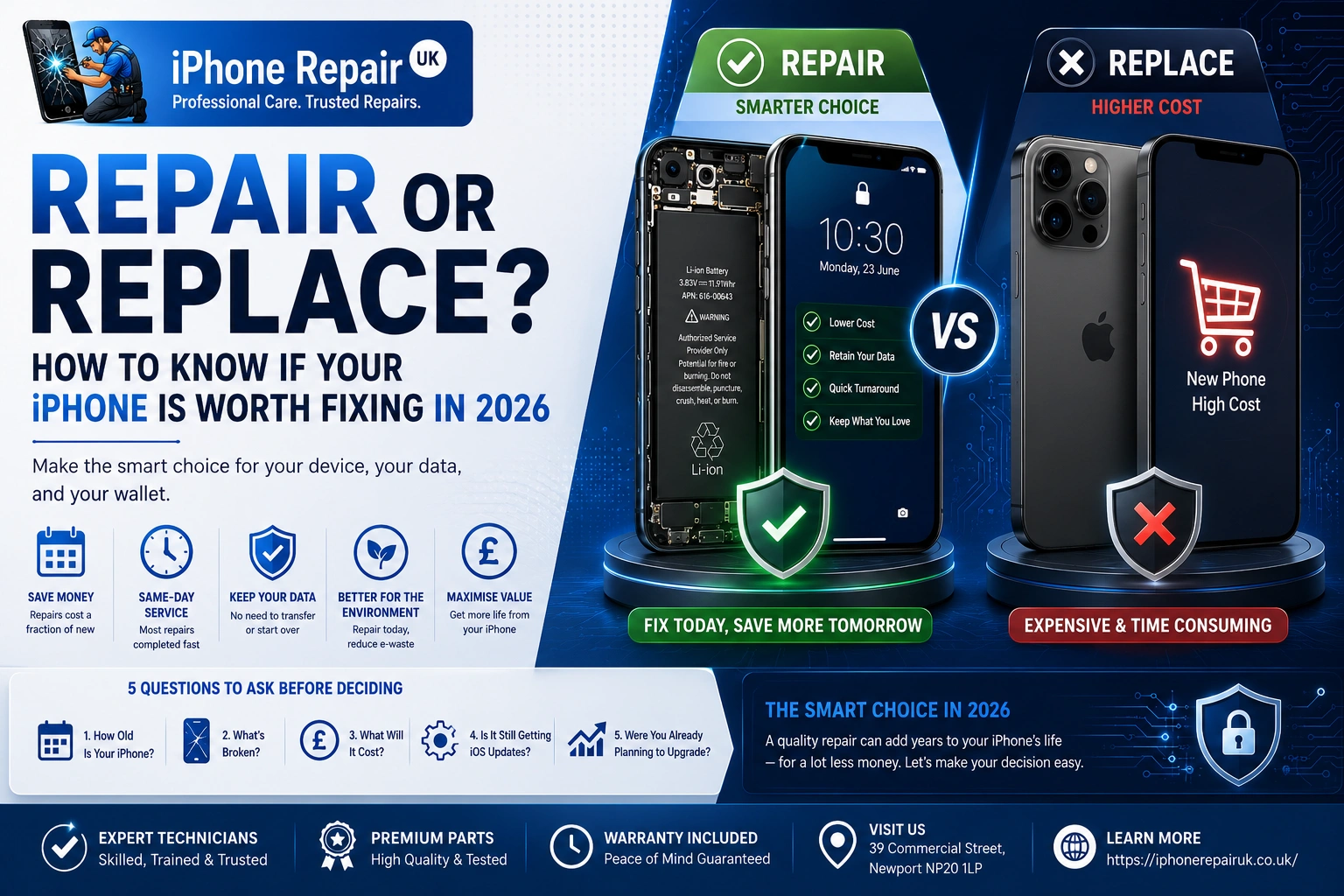
Repair it if the repair cost is less than about half what a like-for-like used replacement would cost, and your phone is under six years old, and it still gets iOS updates whether feature or security, and you weren’t already planning to upgrade.
Consider replacing if the repair cost is more than half what a used replacement costs, or the phone has multiple stacked faults, or it’s on Apple’s obsolete list with no more security updates coming, or you’ve been putting off an upgrade for other reasons anyway.
The rule bends in real life. A £70 battery in an eight-year-old iPhone 8 might still be worth it if the phone is a spare or a work phone or a child’s first mobile. A £250 screen on a two-week-old iPhone 17 is a no-brainer even though it feels expensive. Rules of thumb are for the middle 80% of situations, not the edges. But if you’re going to hold one number in your head, hold that about half line.
The Five Questions To Ask Before Deciding
If you’d like to think through your own situation properly, these are the five questions we walk customers through at the counter.
1. How Old Is Your iPhone?
Age is the single biggest factor. Not because the phone stops working, but because everything else on this list correlates with age — resale value, iOS support, part availability, likelihood of stacked faults.
Under 2 years old means almost always repair because the phone is barely used in its own lifecycle. 2 to 4 years old means nearly always repair because of high resale value, full iOS support, and brand-new specs at a fraction of the new-price cost. 4 to 6 years old means usually repair — iPhone 12, 13, and iPhone SE 3 all fit here in 2026 and they’re brilliant phones with years of software life left. 6 to 8 years old means it depends on what’s broken — iPhone 11 fits here in 2026 and is still on iOS 27, but you’re closer to end-of-life, so repair small things and weigh bigger ones. 8 or more years old covering iPhone X, 8, 7, and earlier means battery yes, screen probably, but multiple faults probably not — the upgrade conversation gets harder to avoid.
2. What’s Actually Broken?
Not all faults are equal. Some are cheap and quick; some are expensive and complicated; some are cheap now but signal worse to come.
A cracked screen only is almost always a repair — it’s the fastest, cheapest, highest-value fix we do. A tired battery only is almost always a repair for the same reasons. A charging port is a repair because it’s common, straightforward, and cheap. A camera lens on the rear is a repair because it’s cheaper than most people expect. Back glass is usually a repair, though on some Pro models the back glass is genuinely expensive because it’s bonded to the frame. Face ID depends — the dot projector is a repair but the whole TrueDepth module is more involved. Water damage requires a diagnostic because sometimes it’s a straightforward dry-out and clean and sometimes it’s logic-board level. Logic-board or motherboard faults mean board-level micro-soldering repair is possible but expensive, and the value case depends heavily on the phone’s age.
3. What Will the Repair Actually Cost?
This is where the free diagnostic and fixed quote matter more than any online table. We won’t quote a price until we’ve had the phone in front of us, because guessing before we see it is how customers get let down at the counter. Bring it in; we’ll tell you what it costs before you commit; you decide from there. The full breakdown of our pricing model and what drives cost is on the Newport iPhone repair costs and turnaround guide.
4. Is Your Model Still Getting iOS Updates?
This is the one people forget most often. iOS support determines whether your phone is a viable long-term daily driver or a phone slowly ageing out of the software ecosystem it lives in.
iOS 27 arriving in autumn 2026 supports the iPhone 11 series and later, plus iPhone SE 2nd gen and later. iOS 26 only covering iPhone XS, XS Max, and XR still gets security patches for a while yet but no new features. iOS 16 was the last for iPhone 8, 8 Plus, and X, and security updates have become intermittent. iOS 15 was the last for iPhone 7 and 6s, which is effectively vintage territory.
If your phone still gets iOS updates, that’s a strong argument for repair. If it’s stuck, that doesn’t mean the phone is unusable — every app you use today will keep working — but factor it in.
5. Were You Already Thinking About Upgrading?
If you were already going to buy a new phone this quarter, this fault is just the deciding push. If you weren’t, and you’d have happily used this phone for another two years except for the crack across the screen, then the repair is the answer to the real question.
Real-World Scenarios (From Our Newport Counter)
Every week we see the same handful of situations. Here’s how the conversation actually goes.
Scenario 1: iPhone 12 With a Cracked Screen
Three-year-old phone, iOS 27 support confirmed, still worth around £220 to £280 second-hand in Newport in good condition. Screen repair is a fraction of the used value. Verdict: repair, no hesitation.
Scenario 2: iPhone 11 With Battery and Slow Charging
Six-year-old phone, iOS 27 support confirmed, battery is the classic six-year problem, charging port likely just needs cleaning. Combined job comes in well under £150 for the pair. Second-hand iPhone 11 with these faults is close to worthless. Fresh screen and battery gives you a phone worth £150 or more that lasts two more years. Verdict: repair.
Scenario 3: iPhone X With a Bulging Battery
Eight-year-old phone. iOS 16 was the last major update. Battery is a safety issue and needs replacing regardless of the keep or upgrade question — you cannot walk out of here with a swollen battery in the phone. Once it’s fixed, do you keep using it? If it’s a daily driver, we’d have a gentle conversation about a second-hand iPhone 12 or 13 giving you a lot more phone for not much more money. If it’s a spare or backup, absolutely keep it. Verdict: fix the battery regardless of what you do next.
Scenario 4: iPhone 8 With Multiple Stacked Faults
Cracked screen, battery on 68%, charging intermittent, home button unresponsive. Individually, each of these is a cheap fix. Together, we’re approaching or exceeding the price of a good second-hand iPhone SE 3rd gen or even an iPhone 11. And the iPhone 8 is off Apple’s iOS list, so you’d be pouring money into a phone that’s on borrowed time software-wise. Verdict: probably time. We’ll say so honestly, and we won’t sell you a repair we don’t believe in.
Scenario 5: iPhone 15 With Smashed Back Glass
Two years old, iOS 27 with Apple Intelligence, arguably still worth £500 or more. Back glass on the iPhone 15 series is a bonded assembly and repair is not trivial, but the cost is nowhere near the phone’s value. Verdict: repair, definitely.
The Hidden Costs Most People Miss
When people compare a £150 repair to a £799 new phone, they compare the sticker prices. The real comparison is broader than that. Here’s what usually goes missing.
Data Migration Time and Hassle
Setting up a new iPhone from an iCloud backup or Quick Start transfer is quicker than it used to be, but it’s still an evening’s work at least. Apps re-download; some need re-authenticating, banking apps in particular; passwords in older apps need re-entering; some apps just don’t restore cleanly. If your time is worth anything, add it to the price of a new phone.
Cases, Chargers and Accessories
Your existing MagSafe case, screen protector, spare cable, car mount, dashboard mount, wireless charger — if your new phone is a different model, some of that gets replaced. Apple’s move to USB-C in the iPhone 15 series orphaned a lot of Lightning accessories; a switch back to a bigger or smaller form factor orphans cases. Budget £30 to £100 for accessory refresh.
Contract Commitment
Choosing a new iPhone on contract usually means locking in for 24 or 36 months. That’s a big financial commitment compared to the flexibility of a repair on a phone you own outright.
Trade-In Value Dropping
The longer you wait to trade in a broken phone, the less it’s worth. A cracked iPhone 12 today is worth more than a cracked iPhone 12 next year, and dramatically more than a cracked iPhone 12 in three years. If you’re going to replace, do it soon. If you’re going to repair and keep, the calculation is simpler — the phone stays useful.
Contract-Locked Upgrade Timing
If you’re mid-contract on your current phone and considering an early upgrade, look at the numbers. Sometimes it’s a small addition; sometimes the upgrade costs more in early-termination fees and residual balances than a repair plus another year of contract. We’re a repair shop, not a phone shop, but we’d rather you know.
The Repair vs Replace Decision Checklist
If you want a quick self-check, here is a plain view. Score honestly. If more items land on the repair side, repair. If more land on the replace side, weigh a replacement carefully.
Age of iPhone under 5 years leans toward repair while 6 or more years leans toward replace. Still receiving iOS updates leans toward repair while on last iOS or none leans toward replace. A single fault such as screen, battery, or port leans toward repair while multiple stacked faults lean toward replace. Repair cost under 50% of used value leans toward repair while over 50% leans toward replace. Not planning an upgrade leans toward repair while already at upgrade point leans toward replace. Preferring to keep the phone as is leans toward repair while being fine with a fresh start leans toward replace. Owning the phone outright with no early-upgrade offer leans toward repair while already being at the upgrade point on contract leans toward replace.
When Replacement Actually Makes Sense
We’re a repair-first business, and we’d rather fix your phone than talk you out of it. But there are honestly some cases where an upgrade is the better call, and we’ll say so when they come up.
The Phone Is Genuinely Obsolete
An iPhone 6s or older, no more security patches, apps starting to drop support, banking apps refusing to open on outdated iOS — that’s a phone at the end of its useful software life. A battery swap doesn’t fix that.
Logic-Board Damage on an Old Model
Board-level repairs on an iPhone 11 or later make sense — we can quote them honestly. On an iPhone 8 or older, the cost of the diagnostic and repair often overlaps with what you’d pay for a solid second-hand upgrade.
Multiple Faults on a Mid-Old Phone
An iPhone XR with a cracked screen, a bulging battery, a dodgy port, and Face ID intermittently failing is a phone where the total repair cost enters “should I just get an iPhone 11 instead” territory. We add it up honestly.
The Camera System on Pro Models
iPhone Pro rear-camera systems are complex, expensive and often integrated. If it’s the camera system that’s damaged on a Pro model and the phone is out of warranty, the repair cost is real. Balance it against the phone’s remaining value.
Where a Local Newport Repair Shop Fits In
You don’t have to decide this on your own. That’s what the free diagnostic exists for.
What We Do at the Counter
You walk in with the phone. We plug it into our diagnostic setup, run through touch, battery health, charging, cameras, mic, speakers, Face ID and connectivity. Ten minutes. We give you a fixed price for the recommended repair, tell you what parts we’d use — genuine or high-quality aftermarket — and tell you honestly whether we think the repair is worth it or whether you should look at a replacement. There’s no obligation. You leave with information you didn’t have when you walked in.
Our Repair Process
If you want to see how a job flows before you bring the phone in, our about page covers who we are and our workshop approach, and the services overview lists everything we do. If you’re weighing us against another shop, that’s fair — how to spot a good repair shop from a bad one is covered in our guide on choosing a reliable iPhone repair service.
The Pay-On-Completion Promise
You don’t pay until the phone is fixed and you’re happy with it. We’ll ring you before we do anything that changes the quote. If we can’t fix it, you don’t pay. That’s the model, and it removes almost all of the risk on your side of the counter.
The Bottom Line
For the vast majority of iPhones broken in 2026, repair is the right answer — economically, environmentally, and for the sake of the phone you’ve already learnt to like. New iPhones are more expensive than ever, contracts lock you in longer, and the software life of even a six-year-old iPhone 11 stretches at least another year. The situations in which replacement is genuinely the better call are narrower than a lot of people assume, and the good news is that you don’t have to work it out on your own.
If you’d like an honest look and a fixed quote, please get in touch with your model, the fault, and — if you can — a photo of the damage. Or come and see us at 39 Commercial Street, Newport, NP20 1HP, between 9am and 6pm Monday to Saturday, or 11am to 4pm on Sunday. You can also ring us on 01633 549755 or WhatsApp 07424 623491 if you’d rather ask before you travel. Whichever you choose, we’ll tell you what we’d do in your position — repair, replace, or somewhere sensible in the middle.