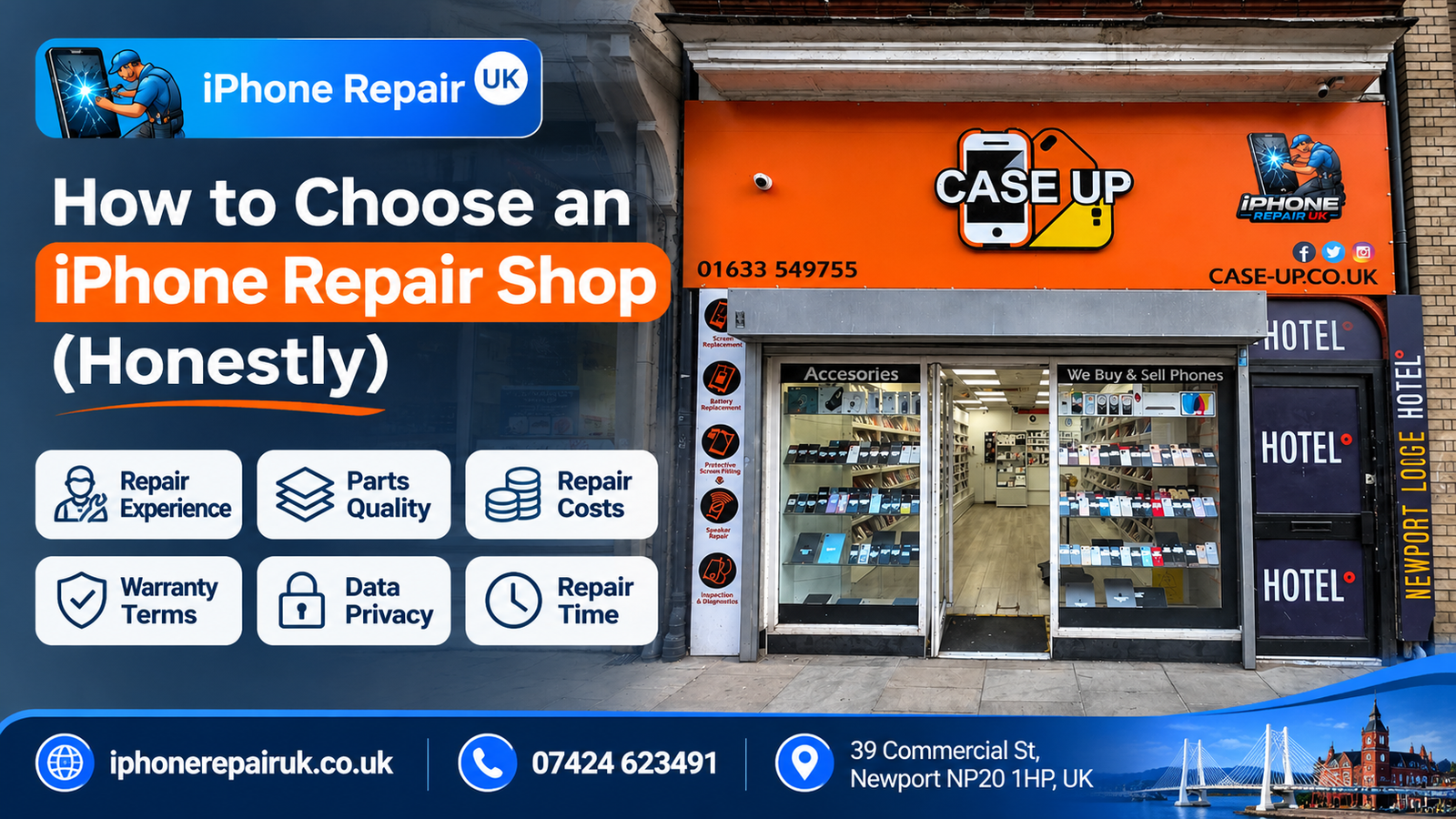
How to Choose an iPhone Repair Shop (Honestly)
When the screen cracks, the battery dies at lunchtime, or the port stops holding a cable, the first instinct is to open Maps and pick the nearest shop with a decent rating. That’s not a bad instinct, but a rating alone will not tell you whether the bench inside the shop is clean, whether the display being fitted to your phone is the right one, or whether the warranty will still mean something nine months from now.
iPhone Repair UK has been at 39 Commercial Street since 2016, repairing Apple devices and nothing else. In that time we have seen most of the mistakes a customer can make, nearly all of them before they even hand the phone over. What follows is what we would pay attention to if we were walking into an iPhone repair shop for the first time.
What you can tell from the shop itself
Walk past, don’t walk in. If you can see through the window and spot a workbench, parts trays, and someone actually working on a device, you are looking at a repair business. If what you can see is a counter, a sign, and nothing else, you are looking at a reception point where the device probably gets forwarded somewhere else. That model is not inherently wrong, several national chains work that way, but the questions you ask should be different, because the person in front of you is not the person doing the fitting.
The shops worth avoiding, consistently, are the ones you cannot find on Google Maps. If the pin shows a residential street, a car park, or a shared mailbox, treat the business as a mobile service rather than a shop, and apply different rules. Mobile technicians who come to you can be fine for the very simplest jobs, a battery swap on an older iPhone, a straight glass-only screen replacement on a non-laminated display. They become risky for anything involving the logic board, calibration, water damage recovery, or recent iPhone generations where the parts are serialised and paired to the device. The reason is unglamorous: dust. A van or a kitchen table is not an anti-static, dust-controlled workspace, and the thinnest flex cables inside a modern iPhone do not forgive either of those.
The parts question
Replacement parts for iPhones fall into four broad tiers:
- Genuine Apple, serialised and paired to the device.
- Refurbished original parts, pulled from working Apple devices, cleaned and tested.
- High-quality aftermarket from reputable manufacturers, tested to match Apple specifications.
- Low-cost generic aftermarket parts, usually sold on consumer marketplaces at prices that should give you pause.
The useful question to ask is not “do you use genuine parts”, because almost every shop will say yes to that regardless. The useful question is “what model of display is this exactly”. A proper answer sounds like “a soft OLED pulled from an iPhone 14 Pro Max, cleaned and tested, with the original adhesive still bonded to the frame”. A vague answer sounds like “a premium OEM screen”. The gap between those two answers is the entire conversation. The differences between the four tiers show up most clearly in how a replacement screen behaves after the fit, which is why a four-tier comparison of what each quality level actually feels like day to day is worth reading before the first repair, not after.
At the iPhone Repair UK bench we lay the part out on the tray before it goes into the phone, and we invite the customer to see it. A sealed-packaging battery, a display in its own padded tray with the model stamp visible, the replacement adhesive strip still in its liner. If a shop will not show you the part before the fit, there is usually a reason.
The Settings app helps here on any iPhone from the iPhone 11 onward. Under Settings, General, About, there is a Parts and Service History panel that shows whether Apple’s calibration system has flagged any of the parts as non-genuine or non-calibrated. That label is not always proof of a bad part. Apple applies it to anything not paired through Apple’s own tools, including some perfectly fine refurbished original components. But it is a useful cross-check against what the shop told you they fitted.
The warranty question
Thirty days is not a warranty. It is a statement that the shop is not confident the repair will survive long enough for you to notice a problem. The useful warranty for any iPhone repair is twelve months, in writing, covering both parts and labour, with a clear process for returning the device if the same fault comes back.
Ask what the warranty specifically covers. Accidental damage, liquid damage, and software issues unrelated to the repair are usually excluded from any sensible warranty, which is fair. What should be covered is any fault in the component the shop fitted, or any workmanship issue, a pinched flex cable, incorrect reassembly, poor adhesive application, that affects the repair they carried out.
A verbal warranty is not a warranty. If the shop will not write it down, assume there is nothing behind it. A useful second test is to ask what happens if the fault reappears on day 340 of a 365-day warranty. The honest shop knows the answer and gives it immediately. A shop that improvises the answer is improvising the warranty.
The water resistance question
The one most owners never think to ask, and the one we would ask every time. Every iPhone from the iPhone 7 onward has an IP rating that depends on the adhesive seal around the display. Every time the phone is opened, that seal has to be replaced correctly for the rating to hold. A shop that does not replace the display adhesive, or does not mention it, is handing back a phone that will not survive the next shower of rain the way it survived the last one.
You can test the question before the repair: ask whether the water resistance will be preserved, and whether the shop replaces the display adhesive as part of the fit. A shop that fumbles the answer is telling you something useful. Properly-done adhesive on a modern iPhone adds a few minutes to the fit and a few pounds to the cost of parts. The shops that skip it are usually skipping it to compete on price.
The transparency question
The ability to see where the repair will happen matters more than most people think. A visible workshop area, a technician who explains what is wrong in plain language, and the chance to see the removed parts after the job is done, all point in the right direction. A device that vanishes through a curtain and comes back “all fixed”, with no explanation, no diagnosis, no returned part, is the kind that tends to come back to us a few weeks later with a problem that could have been avoided.
For screen jobs specifically, the thing to check on collection is whether True Tone, auto-brightness, and haptic touch all still work. A functioning True Tone is a fast indicator that the display pairing has been done properly. If it is missing after the repair, the shop will usually tell you “Apple disabled it”, which is true, but only because the part was not calibrated through Apple’s tools. That is a trade-off worth knowing about before you accept the device back. The full post-repair screen check runs to about five minutes and catches most of the preventable problems.
The data question
Most iPhone repairs do not need your passcode. Screen, battery, port, camera, speaker, back glass, none of these require the shop to unlock the device. A shop that asks for your passcode for a routine repair should be able to explain why, specifically, in advance.
The repairs that do require unlocking are the ones where post-repair testing needs it: Face ID calibration, Touch ID calibration, True Tone verification across different brightness levels, and in some cases a software-related repair where the diagnosis itself requires access. Those are legitimate. A passcode being demanded before the shop will even look at the phone is not.
Backing up before any repair is good practice regardless. iCloud backs up overnight on Wi-Fi, and a Mac or PC can take a full encrypted backup in half an hour. The repair itself should not touch your data, but backups are free insurance.
The turnaround question
For routine repairs, screen, battery, standard camera, charging port, the expected turnaround in Newport is same day. A few hours, usually. Water damage recovery and back glass replacement on fused iPhone 12-onward models take longer because the drying stage after ultrasonic cleaning cannot be rushed and the back glass removal involves laser or heat-plate work. A two-week quote for a screen replacement means the shop is either understocked or sending the device somewhere else to be fitted.
Faster is not always better. A thirty-minute screen replacement that omits fresh adhesive, skips True Tone verification, and gets handed back without a post-fit function check will almost always need a second visit. Same-day repair done properly takes two to four hours of actual bench time, not twenty minutes, and a reasonable shop builds in time for the device to cool after the adhesive is cured before testing.
The price question
The shop that comes in significantly cheaper than every other quote is almost always fitting a lower tier of part, running a shorter warranty, or skipping the adhesive. In repairs as in most trades, the right question is not “is this the cheapest” but “is this the cheapest version of the repair I actually want”.
A fixed quote agreed in writing before work starts, covering parts, labour, adhesive, calibration, and a functional test on completion, is what the price should include. If the quote changes once the phone is open, the shop should tell you before continuing, with the reason. Hidden “diagnostic fees” deducted from the quote only if you proceed are not a cost structure to accept, and a shop that refuses to diagnose the fault without a fee is a shop charging you to find out whether their service is right for you.
What a bad repair looks like, afterwards
Most second-opinion diagnostics that come through iPhone Repair UK are iPhones that have been repaired once elsewhere. The pattern is remarkably consistent. The symptoms we see most often are these.
The screen works but True Tone is missing and auto-brightness is unreliable. The display was not properly paired, usually because the shop does not own the calibration equipment. The customer did not notice at first because the phone was still “working”, then started squinting in bright rooms.
Face ID stopped working after a screen replacement. The sensor assembly was damaged during removal, or not transferred to the new display. We see enough of this that we wrote a separate piece on the seven failure modes that follow a mishandled screen job, because the diagnosis is rarely as simple as “the camera broke”.
The battery runs fine for two weeks, then the phone develops an “Unknown Part” warning in Settings. A non-genuine cell was fitted without calibration, and when iOS re-checked the hardware on an update, the mismatch was flagged.
The charging port works but the phone no longer resists water. The adhesive seal was not replaced, and the phone died in a light rain two months later.
A loose screw rattles inside the chassis. The reassembly was rushed, and the missing screw was found loose inside the frame when we opened it for a different repair.
None of these are catastrophic on their own. All of them are indicators that the first repair was done quickly, cheaply, or by someone working through a backlog. Most can be corrected. If you are currently debating a repair somewhere and any of these descriptions match a previous visit, a second look is almost always worthwhile.
Apple Authorised and Apple-focused are not the same thing
Worth clarifying because the terms get used interchangeably. Apple Authorised Service Providers follow Apple’s processes, use Apple’s parts, and charge Apple’s prices. Their work is excellent, their warranty is clear, and they are the right call for a device still inside its one-year Apple warranty or an active AppleCare+ plan.
Apple-focused independent repair shops specialise in the same devices, but work outside Apple’s authorisation. That usually means lower prices, faster turnaround, and no AppleCare paperwork. The trade-off is that you choose your independent shop carefully, which is what the rest of this piece has been about. iPhone Repair UK is an independent Apple-focused repair shop, not an Apple Authorised Service Provider, and the nine years at the same Commercial Street address are the longer answer to the trust question. Those are different categories, and both are legitimate.
Proximity is not the first filter
The shop two minutes from your house is only worth that proximity if the repair holds up. A shop fifteen minutes further away that gets the repair right the first time saves you three trips, a second repair fee, and the hassle of unpaired Face ID or missing True Tone for the next two years of the phone’s life. Factor quality into “local”. Distance is the tie-breaker, not the first filter.
Seven questions, in the first five minutes
If this piece has been useful, pulled together it reduces to seven questions worth asking in the first five minutes of being inside the shop:
- How long have you been at this?
- Which tier of part will you fit, exactly?
- What is the warranty, in writing, and what does it cover?
- Will True Tone and Face ID still work after the repair?
- Will the water resistance be preserved?
- Can I see where the repair will happen?
- What happens if this does not fix it?
The good shops answer all seven without hesitation. The ones that fidget, change the subject, or treat the questions as suspicious have told you most of what you need to know. Price matters, but price alone is the worst way to decide. A cheap screen that destroys True Tone is a screen you will replace twice. A well-fitted one that preserves it is almost always the cheaper option over the lifetime of the phone.
If you are in Newport and would like a free diagnostic or a second opinion, the iPhone Repair UK workshop is at 39 Commercial Street, open through the week and on Sundays. We will tell you honestly if the repair is worth doing, and honestly if it is not.